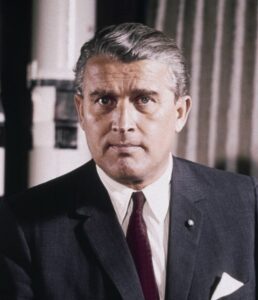
Wernher von Braun
Wernher von Braun 1912-1977
- As technical director at Peenemünde from 1937 and then as first director of NASA's Marshall Space Flight Center from 1960 to 1970, led the engineering teams that developed the V-2 ballistic missile and the Saturn V super-heavy lift rocket — the latter successfully launched thirteen times without loss of crew or payload and remaining the only launch vehicle in history to carry humans beyond low-Earth orbit, enabling six Apollo lunar landings and fulfilling the Defined Output he had articulated as a teenager reading Hermann Oberth.1NASA — Wernher von Braun ↗
- The V-2 programme at Peenemünde and the Mittelwerk underground factory was built on the forced labour of approximately 60,000 concentration camp prisoners from Mittelbau-Dora, of whom approximately 20,000 died from abuse, starvation and execution — a Congruence failure of the most extreme analytical order for a leader who stated his purpose as the exploration of space and the advancement of human knowledge, and whose stated institutional mission was achieved through a production system of mass murder; von Braun's personal knowledge of and responsibility for this system remains historically contested but analytically cannot be set aside.2Wikipedia — Wernher von Braun ↗
- Was brought to the United States under Operation Paperclip in 1945 with 125 German rocket scientists, prevented from facing any accountability for the Mittelbau-Dora deaths by the US government's determination to acquire his expertise for the Cold War space race, and became at NASA a publicly celebrated figure known as 'the father of the American space programme' — the gap between his public recognition and his historical accountability being one of the most analytically significant divergences between the Visibility and Congruence variables in the dataset.3Hack the Moon — Wernher von Braun ↗
Wernher Magnus Maximilian Freiherr von Braun was born on 23 March 1912 in Wirsitz, Prussia, the son of a baron and government minister, developed an obsessive interest in rocketry after his mother gave him a telescope at his confirmation, joined the German Society for Space Travel at seventeen, and began working for the German Army on liquid-fuel rocket development in 1932 — a relationship he accepted as the means of securing funding for the large rockets he wanted to build, regardless of their military application.2Wikipedia — Wernher von Braun ↗ The von Braun profile in the Scientific domain requires a structured engagement with the dual nature of his career: the engineering and institutional leadership achievement on one side, and the moral and ethical catastrophe of the V-2 production system on the other. The equations do not have a mechanism for ignoring one and scoring only the other. They record both. The Peenemünde period (1937-1945) presents the highest-ability, highest-competence snapshot in the profile, combined with the lowest Congruence and Value scores in the dataset. Von Braun led the engineering team that developed the world's first operational ballistic missile — a genuine technical achievement of extraordinary complexity — in a programme that used concentration camp labour administered by the SS.1NASA — Wernher von Braun ↗ The Mittelwerk factory, where V-2s were produced in tunnel systems carved by prisoners from Mittelbau-Dora, killed more people in its construction and operation than the V-2s themselves killed in London and Antwerp. Von Braun visited the Mittelwerk. The degree to which he was aware of, and could have intervened in, the conditions there is historically contested. The degree to which he was responsible for the programme that required it is not. The American period presents a different institutional profile. Von Braun arrived at Fort Bliss, Texas in 1945, moved to Huntsville, Alabama in 1950, became director of the Army Ballistic Missile Agency's Development Operations Division, and became the first director of NASA's Marshall Space Flight Center in 1960. His management style at Marshall — letting every team member know they were important to the team's success, evaluating performance against role-specific standards, taking a conservative engineering approach with ample safety factors — produced a launch vehicle of extraordinary reliability.4NASA Earth Observatory — Von Braun ↗ The Saturn V was launched thirteen times and failed not once. The Congruence variable in the Marshall period scores significantly higher than the Peenemünde period but cannot reach its ceiling: von Braun never publicly acknowledged his responsibility for Mittelbau-Dora, consistently minimised his Nazi Party membership, and accepted the Operation Paperclip amnesty as a condition of his American career. The gap between his stated commitment to the peaceful exploration of space and the means by which he had previously pursued rocket development is analytically present throughout. He died on 16 June 1977 of pancreatic cancer, aged sixty-five. His desk at the Marshall Space Flight Center remains on display at the US Space and Rocket Center in Huntsville.
Score Comparison
Add up to 10 leaders. Click a name to visit their profile.
The 13 Equations
Scores for: NASA Marshall — Saturn V and Apollo ProgrammeThe 22 Variables
Canonical scoresWhat changed: Peenemünde — V-2 Technical Director (Forced Labour Era) → NASA Marshall — Saturn V and Apollo Programme
Sources & Bibliography
The scores assigned to this leader are derived from publicly available sources. Variable inputs reflect documented behaviour, structural conditions, and historical record at the time of each snapshot.