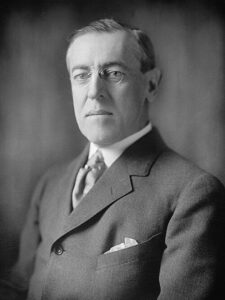
Woodrow Wilson
Woodrow Wilson (1856–1924)
- Woodrow Wilson — son of a Presbyterian minister, academic scholar, President of Princeton University, reforming Governor of New Jersey, and twenty-eighth President of the United States — brought to the White House in 1913 a professorial Vision of progressive governance and international order that produced the Federal Reserve, the income tax, the Clayton Antitrust Act, and American entry into the First World War, making him the most structurally consequential domestic reformer between Roosevelt and Franklin Roosevelt.1Britannica — Woodrow Wilson
- His second term was consumed by the First World War, the Fourteen Points peace framework, the Paris Peace Conference of 1919, and the catastrophic domestic campaign to ratify the League of Nations — which the Senate rejected twice, leaving Wilson's central Vision of collective international security unratified in his own country, institutionalised in Europe without American participation, and vindicated in its diagnosis of what the absence of such a framework would produce twenty years later.2Miller Center — Woodrow Wilson Key Events
- The private record that sits beneath the progressive public legacy — the systematic resegregation of the federal workforce, the screening of Birth of a Nation at the White House, the suppression of dissent under the Espionage and Sedition Acts, and the treatment of Black Americans as categorically outside the democracy he was simultaneously trying to export to the world — is the most direct Congruence failure in the American presidential dataset after Jefferson, driven by the same mechanism: a Vision of human dignity with a racially bounded definition of who counted as human.3History.com — Wilson and Racial Segregation
Woodrow Wilson is the most internally contradictory profile in the American Political domain. He was a genuine visionary whose central idea was correct and whose execution of it destroyed his presidency. He was a progressive reformer whose domestic record excluded a third of the population he governed. He was a man of profound religious conviction whose Humility in theological matters did not extend to political ones. The equations record all of it.
The academic formation period is analytically distinctive. Wilson spent twenty years as a scholar and administrator before entering politics — longer than any other president — and the effect on his variable profile is visible in every subsequent snapshot.1Britannica — Woodrow Wilson The Vision and Intent variables are exceptionally high from the outset, shaped by a man who had spent decades thinking systematically about governance, democracy, and international order. The Humility variable is structured differently from Lincoln's or Carter's — Wilson's humility operated within his intellectual framework, not about it. He could acknowledge tactical error. He could not acknowledge that his fundamental analysis might be wrong. That distinction runs through every major decision of his presidency.
The First Term domestic programme is the most productive legislative period of any Democratic presidency before the New Deal. The Federal Reserve Act of 1913 created the central banking architecture that still governs American monetary policy.4Federal Reserve — History The Sixteenth Amendment establishing the income tax, the Clayton Antitrust Act strengthening Sherman, the Federal Trade Commission — all passed in the first term, all reflecting a Process variable operating at high efficiency through a Democratic Congress that Wilson managed with a directness that surprised legislators accustomed to more indirect presidential pressure. The People variable in this period is strong: William McAdoo at Treasury, William Jennings Bryan at State, and a working relationship with congressional leaders that produced legislation of lasting structural consequence.
The resegregation of the federal workforce in the same period requires explicit treatment in the Congruence variable. Wilson's postmaster general and treasury secretary — with Wilson's knowledge and approval — introduced segregated cafeterias, bathrooms, and working spaces into federal departments that had been integrated since Reconstruction.3History.com — Wilson and Racial Segregation Black federal employees were demoted or dismissed. When a delegation of Black leaders led by Monroe Trotter confronted Wilson directly, he had them removed from the White House. The Congruence score does not collapse entirely because Wilson's public progressive positions were largely enacted — but the gap between his stated democratic principles and their racially selective application is structural, not occasional, and the score reflects it.
The war period is where the variable profile reaches its most complex expression. American neutrality until 1917 reflected genuine strategic calculation rather than passivity — Wilson understood that entry would transform both the war and America's postwar position.2Miller Center — Woodrow Wilson Key Events The Fourteen Points, articulated in January 1918, were the most ambitious framework for postwar international order ever proposed by a sitting head of government — self-determination of peoples, freedom of the seas, open diplomacy, and the League of Nations as the institutional mechanism for collective security.5Yale Avalon Project — Fourteen Points The Vision variable at this moment is at its ceiling. The gap between that Vision and what the Paris Peace Conference actually produced — a punitive settlement that Wilson partially enabled by trading away his principles to preserve the League — is the most consequential single Congruence failure in twentieth-century diplomatic history.
The domestic suppression of dissent under the Espionage Act of 1917 and Sedition Act of 1918 runs directly against Wilson's stated commitment to democratic freedom of expression.6ACLU — Espionage and Sedition Acts Eugene Debs was imprisoned for a speech opposing the draft. The postmaster general suppressed socialist publications. The same president who was arguing for self-determination of peoples in Europe was jailing Americans for criticising his war policy at home. The Congruence variable records this without ambiguity.
The League of Nations campaign is the analytical centrepiece of the post-war period and the clearest single illustration of the Humility variable's absence at the critical moment. Wilson's physician, his wife, and his closest advisers all urged compromise with Senate Republicans — accepting reservations to the League Covenant that would have secured ratification with modifications.2Miller Center — Woodrow Wilson Key Events Wilson refused. He took his case directly to the American people in a cross-country speaking tour that ended with a stroke in Pueblo, Colorado, in September 1919 — leaving him incapacitated for the final seventeen months of his presidency, during which his wife Edith effectively managed access to the president and filtered government business. The Senate rejected the League twice. The Adaptability variable at this snapshot is the lowest in the profile. The Conviction variable remains at 10 throughout, which is precisely the problem.
The stroke and its aftermath represent the most severe institutional failure of presidential incapacity in American history. Wilson governed — or did not govern — for seventeen months in a condition his cabinet was not permitted to assess and the public was not told about.7History.com — Wilson's Stroke The People variable at this point reflects not the quality of his appointments but the structural absence of any mechanism for managing presidential incapacity — a gap the Twenty-Fifth Amendment eventually addressed forty-six years later.
The number that matters most across all four snapshots is the relationship between Vision and Humility. Wilson's Vision score is among the highest in the dataset — his diagnosis of what international order required was correct, vindicated by everything that followed its rejection. His Humility score is the variable that prevented him from saving his own idea. A leader with Vision 10 and Humility 8 ratifies the League with reservations and changes the twentieth century. Wilson's Humility at the critical moment scored 4. That gap is the Leaderment profile of Woodrow Wilson.
Score Comparison
Add up to 10 leaders. Click a name to visit their profile.
The 13 Equations
Scores for: Princeton and New Jersey — Academic to ExecutiveThe 22 Variables
Canonical scoresSources & Bibliography
The scores assigned to this leader are derived from publicly available sources. Variable inputs reflect documented behaviour, structural conditions, and historical record at the time of each snapshot.