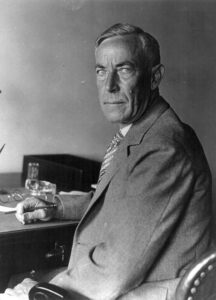
August Vollmer
August Vollmer (1876 - 1955)
- Served as Berkeley's first police chief from 1909 to 1932 and in that role became the single most influential reformer in the history of American policing — creating the first continuous police training programme, requiring officers to hold college degrees, putting police on bicycles (1910), motorcycles (1911) and patrol cars with radio communications (1913 and 1928), establishing centralised criminal records, and applying blood, fibre and soil analysis to criminal investigation before forensic science existed as a formal discipline in any American police department.1Wikipedia — August Vollmer ↗
- Persuaded the University of California to establish a criminal justice programme in 1916, which he headed, training officers who went on to lead police departments across the United States — and subsequently founded the School of Criminology at UC Berkeley, establishing criminal justice as a university academic discipline for the first time and creating a pipeline between higher education and law enforcement that became the structural foundation of police professionalisation in America.2Berkeley News — Vollmer Biography ↗
- Personally read the Memoirs of Vidocq as part of his self-education, acknowledged Vidocq as a founding influence, and then exceeded Vidocq's institutional legacy by producing a model of policing that could be systematically taught, replicated, and sustained without the founder — training officers such as O.W. Wilson who themselves became leaders of the professionalisation movement, creating the defining characteristic of genuinely durable institutional innovation: a system that outlasts and outgrows its creator.3Berkeleyside — August Vollmer ↗
August Vollmer was born on 7 March 1876 in New Orleans to German immigrant parents, lost his father young, moved with his mother to Berkeley, California, served in the Spanish-American War in the Philippines, returned to Berkeley as a letter carrier, became famous locally for leaping onto a runaway freight car to prevent a collision with a passenger coach, and was elected town marshal on the strength of that reputation in 1905.1Wikipedia — August Vollmer ↗ He had a sixth-grade education. He became the defining figure in the professional development of American policing. The analytical framework for Vollmer within the Law Enforcement domain requires a precise distinction between two types of leadership contribution. The first is operational: what did he do to the Berkeley Police Department during his twenty-three-year tenure? The second is systemic: what did he change about the structure of American policing that outlasted his tenure? Both require separate variable analysis, but the second is where his profile most decisively separates itself from every other figure in the dataset. Operationally, Vollmer arrived at a police department where officers were known more for taking bribes from gambling parlours than for preventing crime, immediately banned graft, introduced training, established a records system, and within ten years had turned Berkeley's ten-man force into the most technically advanced police department in the United States.4City Journal — Vollmer Legacy ↗ The technological innovations — motorcycle patrols, patrol cars, radio communications, lie detector use, forensic analysis — were not gadgetry but systematic applications of the principle that policing should be evidence-based rather than intuition-based. He was applying the scientific method to law enforcement thirty years before it became standard practice. Systemically, the Process variable in Vollmer's profile reflects something that almost no other leader in the Law Enforcement domain achieved: he built a model that could be replicated and taught without him. Bratton's CompStat spread because it was a management system. Vollmer's reforms spread because he trained the people who spread them.1Wikipedia — August Vollmer ↗ His protégés became police chiefs across the country. O.W. Wilson, his most famous student, became a professor and continued the professionalisation movement, establishing the first police science degree at what is now Wichita State University. The School of Criminology at UC Berkeley trained generations of law enforcement professionals. The academic infrastructure of policing in America was substantially Vollmer's creation. His Value variable reflects both the genuine and the problematic dimensions of his legacy. The professionalisation project was real, beneficial, and measurable — Berkeley's crime rate fell, and American policing became substantially more educated and evidence-based under his influence. But his theoretical framework included pseudoscientific views on racial types and heredity as contributors to crime — ideas that were mainstream social science of his era but that contributed to a professionalised policing model whose racial enforcement patterns are analytically inseparable from the theories he taught.5KQED — August Vollmer ↗ The equations record what he built. The full analysis requires both the achievement and the cost. He retired from Berkeley in 1932 as his eyesight failed, joined the UC Berkeley faculty, was awarded the Public Welfare Medal by the National Academy of Sciences in 1934, and helped establish what became the American Society of Criminology in 1941. He took his own life on 4 November 1955, aged seventy-nine, suffering from cancer and Parkinson's disease. Vollmer Peak in the Berkeley Hills — also known as Bald Peak — is named in his honour.
Score Comparison
Add up to 10 leaders. Click a name to visit their profile.
The 13 Equations
Scores for: Berkeley Police Chief — Reform PeakThe 22 Variables
Canonical scoresSources & Bibliography
The scores assigned to this leader are derived from publicly available sources. Variable inputs reflect documented behaviour, structural conditions, and historical record at the time of each snapshot.