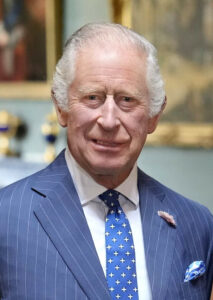
Charles III
Charles III (born 1948)
- Founded the Prince's Trust in 1976 with £7,500 of Royal Navy severance pay — it grew into the United Kingdom's largest youth charity, supporting over a million young people and creating 125,000 entrepreneurs across five decades.1Wikipedia — Charles III His Prince's Charities collectively raised more than £100 million annually.1Wikipedia — Charles III
- Warned publicly about plastic pollution and climate change fifty years before either became mainstream policy concerns2Britannica — Charles III — described at the time as eccentric, later vindicated by the scientific and political consensus — while privately lobbying ministers through the handwritten correspondence known as the black spider memos.
- Became King at 73, the oldest person ever to accede to the British throne and the longest-serving heir apparent in British history,1Wikipedia — Charles III acknowledging in his accession speech with unusual precision that it would no longer be possible for him to give so much of his time and energies to the charities and issues for which he cared so deeply.
Charles III is the dataset's most analytically unusual Royalty domain profile because his pre-reign period contains more genuine leadership substance than his reign. Every other monarch in the dataset arrives at the throne as the culmination of their variable profile. Charles III arrived at the throne having spent seven decades building a mission that the role of King required him to largely abandon. His accession speech acknowledged this with unusual precision — a leader describing, in public, the Defined Output reduction that the equations record in the transition to the reign snapshot.2Britannica — Charles III
The early Prince of Wales period is the profile's most analytically honest snapshot. The Prince's Trust, founded in 1976 with £7,500 of Navy severance pay, grew into the United Kingdom's largest youth charity.1Wikipedia — Charles III The environmental advocacy — plastic pollution flagged fifty years before it became mainstream, climate change warnings issued when the political establishment considered the subject eccentric — is Conviction operating at documented maximum against genuine institutional resistance.2Britannica — Charles III The black spider memos, his private lobbying letters to government ministers in his distinctive handwriting, generated significant criticism precisely because they demonstrated a Prince of Wales with real convictions who was willing to deploy them through whatever channels his structural position permitted. The high Corporate Drag score in this period is not a failure of the institution to appreciate him. It is an accurate record of an institution resisting a leader whose variable profile was misaligned with the role's formal requirements.
The architectural campaigns deserve specific analytical attention because they illustrate how Conviction and Process can operate effectively within severe Autonomy constraints. His description of a proposed National Gallery extension as a monstrous carbuncle — delivered publicly, without institutional sanction, in direct contradiction of the professional consensus — was not careless. It was a deliberate deployment of the one form of influence available to a constitutional heir: the ability to shape public discourse without formal authority. Poundbury, the urban extension to Dorchester built on his own land to his own architectural principles, was the same mechanism applied constructively — using Resources and Autonomy in the one domain where he had genuine operational freedom to demonstrate rather than merely advocate.1Wikipedia — Charles III
The Diana period is the profile's lowest point and the Congruence score carries the analytical weight. The gap between his public role — heir to the throne, embodiment of institutional continuity, representative of duty and service — and the private reality of a marriage that had collapsed and a relationship with Camilla Parker Bowles that was ongoing throughout — is the say-do gap the equations must record.2Britannica — Charles III The Dimbleby interview admission of the affair, the Panorama broadcast by Diana, the separation and subsequent divorce — these were not individually decisive Congruence events. They were the public surfacing of a gap that had existed for years and that the Royal Household had managed with decreasing success. The equations record that Diana's personal variable profile generated Recognition that his could not match in this period, and that the resulting asymmetry suppressed his Effective Power to its lowest point.
The consolidation period is the analytical peak for reasons that the variable changes explain precisely. Chaos reduces as Pride adjusts — not through any single event but through the gradual accommodation of his actual life. The marriage to Camilla in 2005 resolved the Congruence gap that had defined the previous decade.2Britannica — Charles III The growing public acceptance of his environmental and social causes — not because his positions changed but because the world moved toward them — improved his Environment score and reduced Competition. The Prince's Charities raising over £100 million annually, the Accounting for Sustainability Project, the Duchy Originals brand, the Dumfries House rescue — these are Process and People and Defined Output operating at their documented maximum within a structural context that had finally reached some alignment with his variable profile.1Wikipedia — Charles III
The reign snapshot records a genuine Conviction reduction. A leader who spent decades writing private lobbying letters to government ministers about organic farming, architecture, climate change and alternative medicine became, on accession, constitutionally required to maintain the political neutrality his mother had upheld throughout her reign. The cancer diagnosis in 2024 added a further constraint on operational capacity.3Biography.com — Charles III Conviction in the reign period reflects not a change of belief but the requirement of its suppression. Humility in the reign period reflects genuine adaptation to that requirement. A leader with lower Humility would have found the constraint psychologically impossible. Charles III, having spent seven decades operating within structural constraints that prevented direct expression of his convictions, had developed the Humility to manage the transition.
The profile's central analytical tension is between the Autonomy ceiling that defines every snapshot — never high, constrained further in the reign itself — and the Conviction score that remains the highest in his record across every period. A leader with high Conviction operating within low Autonomy is the Leaderment Codex description of the most common form of institutional frustration. The equations record that Charles III produced more genuine value as Prince of Wales than any heir in the dataset, and that arriving at the throne required him to reduce the outputs that had defined his leadership identity. The monarchy gained a King. British public life lost its most persistent and analytically credible voice for causes that history has largely vindicated.
Score Comparison
Add up to 10 leaders. Click a name to visit their profile.
The 13 Equations
Scores for: Diana Years — Public CrisisThe 22 Variables
Canonical scoresWhat changed: Prince of Wales — Early Period → Diana Years — Public Crisis
Sources & Bibliography
The scores assigned to this leader are derived from publicly available sources. Variable inputs reflect documented behaviour, structural conditions, and historical record at the time of each snapshot.