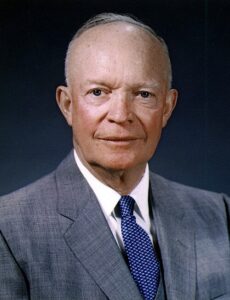
Dwight Eisenhower
Dwight Eisenhower (1890–1969)
- Dwight David Eisenhower — son of a Kansas creamery worker, West Point graduate, staff officer who spent the First World War stateside, protégé of Fox Conner and George Marshall, planner of the North Africa and Sicily landings, and Supreme Commander of the Allied Expeditionary Force for the invasion of Europe — was the most experienced military executive ever to reach the American presidency, carrying into the White House in 1953 a People and Process variable baseline built across thirty years of managing coalitions of difficult personalities under existential pressure.1Britannica — Dwight D. Eisenhower
- His two terms from 1953 to 1961 produced the Interstate Highway System, the creation of NASA, the desegregation of Little Rock's schools by federal troops, the ending of the Korean War, the Atoms for Peace initiative, and a sustained period of American economic prosperity — while simultaneously managing the most dangerous decade of the Cold War through a strategic doctrine of massive retaliation and covert action that kept the United States out of direct armed conflict at a time when the pressure to enter it was constant.2Miller Center — Dwight Eisenhower Key Events
- The farewell address of January 1961 — warning against the acquisition of unwarranted influence by the military-industrial complex — delivered by the Supreme Commander of the largest military operation in history, is the most analytically precise piece of political communication in the postwar American dataset: a five-star general telling his country that the institution he had led was becoming a structural threat to the democracy it existed to defend.3Eisenhower Library — Farewell Address
Dwight Eisenhower is the most consistently underestimated profile in the postwar American Political domain and the leader whose reassessment has moved most dramatically as the archival record has opened. The contemporary perception — affable, passive, golf-playing president presiding over a quiet decade — is almost entirely wrong. The equations capture what the archives confirm: a leader of exceptional strategic intelligence operating through deliberate concealment of his own capability, whose management style was so effective that its effectiveness was invisible.
The military formation period established a variable baseline unlike any other president in the dataset. Eisenhower spent the interwar years working for MacArthur in the Philippines — an experience that taught him precisely what narcissistic leadership looked like from close range and reinforced his own instinct toward collaborative management.1Britannica — Dwight D. Eisenhower His selection by Marshall to plan Operation Torch — the North Africa landings — over 366 more senior officers reflects a People variable operating from the other direction: Marshall could identify the capability that the rank order concealed. Eisenhower's subsequent management of the Allied coalition — holding together Montgomery, Patton, de Gaulle, and Churchill while executing the most complex military operation ever attempted — is the People and Process variables at their absolute ceiling under maximum pressure.
The decision to run as a Republican rather than a Democrat — both parties approached him in 1952 — is analytically significant. Eisenhower chose the party whose isolationist wing was most likely to obstruct the internationalist foreign policy he considered essential, specifically to be positioned to contain that wing from within.2Miller Center — Eisenhower Key Events That is the Vision and Process variables operating in combination before he had even taken office — choosing his institutional constraints deliberately in order to manage them.
The hidden-hand presidency is the central analytical concept of the Eisenhower record. Scholars who accessed his private papers from the 1980s onwards found a president who read more, decided more, and directed more than his public presentation suggested — deliberately projecting an image of benign passivity while managing events through staff systems and back channels that kept his own fingerprints off the most politically sensitive decisions.4Eisenhower Presidential Library — Documents The Intent variable across all snapshots is among the highest in the dataset — every public communication was precisely calibrated. The Congruence variable is consequently complex: the public Eisenhower and the private Eisenhower were not identical, but the gap served strategic rather than personal purposes.
The Korean armistice of July 1953 — achieved within six months of taking office — reflects Decisiveness and Communication in combination. Eisenhower ended a war that his predecessor had been unable to conclude by signalling through back channels that he was willing to use nuclear weapons if negotiations failed, while simultaneously restructuring the military budget toward nuclear deterrence and away from conventional forces.5US State Department — Korean War Armistice The New Look defence strategy that followed — more nuclear capability, fewer conventional troops, lower cost — reflects the same logic: maximum deterrent effect per dollar of defence spending, managed by a man who understood military capability from the inside and was immune to the institutional pressures that inflate defence budgets.
The Little Rock crisis of 1957 is the most analytically precise test of the Decisiveness variable in the domestic record. When Arkansas Governor Orval Faubus used the National Guard to prevent Black students from entering Central High School, Eisenhower — who privately doubted the pace of desegregation and had not enthusiastically supported Brown v. Board of Education — nevertheless federalised the Arkansas National Guard and sent the 101st Airborne Division to enforce the court order.6Eisenhower Library — Little Rock Crisis The decision was made on constitutional grounds rather than moral ones — federal law would be enforced — and it was made without hesitation once Faubus forced the issue. The Congruence variable at this snapshot is higher than Eisenhower's private views on race would predict, because his constitutional Conviction overrode his personal ambivalence.
The covert action record sits in permanent tension with the public Eisenhower. The CIA operations that overthrew Mossadegh in Iran in 1953 and Árbenz in Guatemala in 1954 — both authorised by Eisenhower — produced short-term strategic outcomes and long-run consequences that have not improved with time.7US State Department — Iran Coup 1953 The Value variable records both the strategic logic and the downstream outcomes. The Congruence variable records the gap between Eisenhower's public commitment to self-determination and these specific applications of American power.
The U-2 incident of May 1960 — a CIA reconnaissance aircraft shot down over the Soviet Union, producing a summit collapse and the most significant diplomatic failure of the presidency — reflects the Risk and Adaptability variables at their lowest point in the profile.8US State Department — U-2 Incident Eisenhower's initial denial that the aircraft was a spy plane — before the Soviets produced the pilot — is the single largest Congruence gap in the record. He recovered, admitted the truth, and absorbed the diplomatic consequences, but the Paris summit that might have produced a nuclear test ban treaty did not survive it.
The farewell address is the most important document Eisenhower produced and the one that most precisely captures the Vision variable operating without institutional constraint for the first time in his presidency. Warning against the military-industrial complex, the scientific-technological elite, and the capture of public policy by organised interests — delivered by the man who had commanded all three — is Vision and Congruence operating simultaneously at their ceiling.3Eisenhower Library — Farewell Address He had seen the dynamic from the inside for thirty years. He waited until he had nothing left to lose politically before saying so in public. That timing is itself analytically significant.
The number that matters most across all four snapshots is Process — specifically the hidden-hand management system that Eisenhower constructed and operated with a consistency no other president has matched. He built a National Security Council that actually functioned as a decision-making body. He used the staff system to surface options, stress-test assumptions, and distribute decisions to the appropriate level. He managed coalitions of extraordinary difficulty — Allied commanders, congressional leaders, cabinet members, foreign heads of government — without the ego investment in specific outcomes that causes most leaders to override the systems they build. That Process variable, sustained across eight years of Cold War crisis management, is the analytical signature of Dwight Eisenhower.
Score Comparison
Add up to 10 leaders. Click a name to visit their profile.
The 13 Equations
Scores for: Supreme Commander — OVERLORD and Victory in EuropeThe 22 Variables
Canonical scoresSources & Bibliography
The scores assigned to this leader are derived from publicly available sources. Variable inputs reflect documented behaviour, structural conditions, and historical record at the time of each snapshot.
- Britannica — Dwight D. Eisenhower biography
- Miller Center — Dwight Eisenhower Key Events
- Eisenhower Presidential Library — Farewell Address
- Eisenhower Presidential Library — Online Documents
- US State Department — Korean War Armistice
- Eisenhower Library — Little Rock Crisis
- US State Department — Iran Coup 1953
- US State Department — U-2 Incident