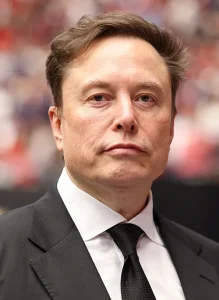
Elon Musk
Elon Musk (born 1971)
- Born in Pretoria, South Africa, left at 17 to avoid apartheid and military service, sold his first company Zip2 to Compaq for $307 million in 1999, co-founded PayPal which sold to eBay for $1.5 billion in 2002, then committed his entire personal fortune simultaneously to SpaceX and Tesla1Wikipedia — Elon Musk — in 2008, with three consecutive Falcon 1 launches failed, Tesla on the verge of bankruptcy in the worst economic climate since the Great Depression, and SpaceX down to its last launch attempt, he invested his final available cash into Tesla on Christmas Eve, the Tesla financing round closing in the last hour of the last day before payroll would have bounced two days later.2Startup Archive — Musk saves Tesla and SpaceX 2008
- The fourth Falcon 1 launch succeeded in September 2008 — the first privately funded liquid-fuelled rocket to reach orbit — NASA awarded SpaceX a $1.6 billion contract three months later, Tesla survived and scaled through the Model S, Model X, Model 3 and Model Y to become the world's most valuable car company, and Starlink deployed over 7,000 satellites accounting for more than half of all active satellites in orbit3Britannica — Elon Musk — with Musk named Time Person of the Year in 2021 and becoming the world's wealthiest person.
- Acquired Twitter in October 2022 for $44 billion after an impulsive offer, attempted reversal, and legal compulsion to complete the transaction — entered the building carrying a sink, dismissed approximately half the workforce within days, watched the advertiser exodus that followed, rebranded the platform as X1Wikipedia — Elon Musk — then in 2025 led the Department of Government Efficiency under Donald Trump before announcing his departure in May of that year amid disagreements, his net worth as of April 2026 estimated at $809 billion.
Elon Musk is the most analytically extreme profile in the dataset. No other leader demonstrates a variable trajectory of equivalent range — from the near-bankruptcy conditions of 2008, where Conviction of ten and Ambition of ten were being expressed through Resources of three against a severely adverse k, to a Transformational peak in 2021, to a Powerless score generated entirely by self-inflicted Chaos in 2023. The external environment did not produce the Twitter collapse. The equations record a neutral k. The damage was internal, and the mechanism was the progressive uncoupling of Ego and Pride from the feedback systems that had previously corrected them.
The founding period is the most instructive snapshot. Most leaders who score Conviction at ten are wrong. Musk was right — about reusable rockets, about electric vehicles at scale, about the commercial viability of both when every incumbent industry dismissed the premises. The near-bankruptcy of Tesla in 2008, the three consecutive Falcon 1 failures, and the commitment of his personal PayPal fortune to both companies simultaneously describe a leader operating at the outer limit of what Conviction without Resources can sustain.2Startup Archive — Musk saves Tesla and SpaceX 2008 That the system survived is partly a function of the variables and partly a function of k eventually turning — the fourth Falcon 1 launch succeeded, NASA contracted SpaceX, and the conditions that had suppressed Progress shifted.
The ascent period reveals the structural advantage that separates Musk from most high-Conviction leaders. At SpaceX's peak, twenty-one executives reported to Gwynne Shotwell and four to Musk. She provided the operational architecture — Process, Defined Output, People management — that his variable profile structurally cannot generate alone. The equations explain why that division of labour produced exceptional results. Leadership multiplied by Management produces Leaderment, and Musk's Leadership scores were extraordinary while his Management scores were not. Shotwell supplied the Management. The Twitter acquisition had no equivalent.3Britannica — Elon Musk
What the peak productive period makes visible is that Musk's extraordinary numerators were, for a specific window, operating against a denominator that had not yet grown beyond their capacity to overcome it. Chaos at this period is produced by an Ego and Pride product that is not low — it is being overcome by Conviction, Ambition, Resources, and an Environment producing exceptional external tailwinds. When those tailwinds were absent, as in 2023, and when Ego and Pride had escalated further, the denominator consumed the numerator entirely.
The Twitter acquisition is the dataset's clearest illustration of the Chaos equation as a diagnostic tool. The acquisition was not a strategic decision in the conventional sense — it was an identity event. The documented sequence — impulsive offer, attempted reversal, legal compulsion to complete, theatrical entrance with a sink — describes a leader whose Pride had made a public position irreversible regardless of its merits. The subsequent mass layoffs, the elimination of the communications department, and the advertiser exodus each correspond to specific variable movements: Process dismantled, Intent eliminated, Corporate Drag generated at maximum rate, Congruence collapsed between the stated free speech mission and the firing of employees for internal dissent.1Wikipedia — Elon Musk The equations did not need to know the story. They calculated the outcome.
The single most important observation in the Musk profile is that his Chaos floor has never been low. Even at his most productive, Ego and Pride sat above the human baseline. His peak Effective Power was achieved not because internal friction was low but because his numerators were extraordinary enough to overcome a permanently elevated denominator. That headroom eventually ran out — not because the numerators collapsed, but because the denominator grew faster than any numerator could compensate for.
Score Comparison
Add up to 10 leaders. Click a name to visit their profile.
The 13 Equations
Scores for: PayPal / Early Tesla-SpaceXThe 22 Variables
Canonical scoresSources & Bibliography
The scores assigned to this leader are derived from publicly available sources. Variable inputs reflect documented behaviour, structural conditions, and historical record at the time of each snapshot.