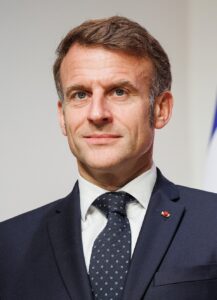
Emmanuel Macron
Emmanuel Macron (born 1977)
- Born in Amiens, studied philosophy before completing a master's in public affairs at Sciences Po and graduating from the École nationale d'administration — worked as a finance inspector, then as an investment banker at Rothschild, was appointed Economy Minister under François Hollande in 2014, resigned in 2016, founded En Marche less than a year before winning the presidency in May 20171Wikipedia — Emmanuel Macron — becoming at 39 the youngest person ever elected to the role, having never previously held elected office, having demolished the French party system in twelve months, and defeating Marine Le Pen with more than 66 percent of the vote.
- Was re-elected in 2022 — the first French president to win a second term since Jacques Chirac — but lost his parliamentary majority in the subsequent legislative elections, was forced to pass pension reform by constitutional decree in March 2023 bypassing parliament, and in June 2024 dissolved the National Assembly after his party received 14.6 percent of the vote in the European elections, finishing nearly 17 points behind Le Pen's Rassemblement National1Wikipedia — Emmanuel Macron — producing a hung parliament with three irreconcilable blocs, his appointed Prime Minister Michel Barnier ousted by a no-confidence vote in December 2024 after just three months in office.2Wikipedia — 2024 French legislative election
- Acknowledged in a New Year address that his decision to call the snap election "has produced more instability than peace" and that "the dissolution caused more divisions in the Assembly than solutions for the French people"3France 24 — Macron acknowledges snap election instability — a rare public mea culpa from a leader whose defining characteristic has been the certainty that the same instinct was correct — and continues to navigate the Trump relationship while attempting to sustain European defence coalition with two years remaining on a term he cannot constitutionally extend.
Emmanuel Macron became President of France in 2017 at the age of 39, the youngest person ever elected to the role. A former investment banker and economy minister under François Hollande, he founded his own political movement — En Marche — less than a year before winning the presidency, positioning himself explicitly as neither left nor right. It was one of the most audacious political manoeuvres in modern European history.
His first term was defined by ambition and collision. He pushed through significant labour market reforms, survived the gilets jaunes protest movement that paralysed France for months, and positioned himself as the leading voice for European strategic autonomy.4Britannica — Emmanuel Macron He was re-elected in 2022 against Marine Le Pen — the second time he had defeated her — but with a reduced majority in the National Assembly that transformed his second term into a governing ordeal.
His decision to call a snap parliamentary election in June 2024, following the European Parliament results in which his party was badly beaten by Le Pen's Rassemblement National, proved to be a significant miscalculation. The election produced a hung parliament with three irreconcilable blocs, leaving France functionally ungovernable and Macron a lame duck president with two years remaining on a term he cannot constitutionally extend.2Wikipedia — 2024 French legislative election
Macron is a genuinely high-ability leader trapped in an increasingly hostile environment. His Charisma is real — he commands a room, navigates multilateral diplomacy with rare fluency, and thinks strategically across long timeframes. His Confidence has historically been his greatest asset and his most significant liability: the same certainty that drove his early reforms produced the 2024 snap election decision that unravelled his presidency.
His Defined Output has degraded significantly. In 2017 it was exceptionally clear — transform France, lead Europe. By 2025 it is survival and legacy management. His Environment score is among the worst of any current Western leader: a hostile parliament, a resurgent far right, a fractured left, and a public that has largely concluded his presidency is over in all but name. The 2023 pension reform by constitutional decree is the Congruence event that the equations record most precisely — a leader who had built his political identity on democratic renewal bypassing parliament to pass the most unpopular policy of his administration.4Britannica — Emmanuel Macron
The snap election was the Confidence variable catastrophically misapplied. He had a model of the world in which clarifying elections produced mandates. He applied it to a political environment where the electorate had fundamentally changed. The equations recorded it as Cameron recorded Brexit: the same variable, differently contextualised, producing the same category of outcome.
Score Comparison
The 13 Equations
Scores for: Second TermThe 22 Variables
Canonical scoresWhat changed: First Term Peak → Second Term
Sources & Bibliography
The scores assigned to this leader are derived from publicly available sources. Variable inputs reflect documented behaviour, structural conditions, and historical record at the time of each snapshot.