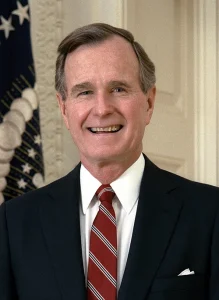
George H.W. Bush
George H.W. Bush (1924–2018)
- Born in Milton, Massachusetts, the son of a US Senator, flew 58 combat missions as the Navy's youngest pilot during the Second World War, then served as UN Ambassador, Republican National Committee Chairman, US Liaison to China, Director of Central Intelligence and two-term Vice President — arriving at the presidency in January 1989 with a curriculum vitae that no American president before or since has matched1Wikipedia — George H.W. Bush — and at the 1988 Republican National Convention delivering the most consequential single say-do commitment in this dataset: "Read my lips: no new taxes."2Britannica — George H.W. Bush
- Assembled a 34-nation coalition with UN Security Council authorisation and Arab League participation, liberated Kuwait in 100 hours in February 1991, and reached an approval rating of 89 percent1Wikipedia — George H.W. Bush — then in October 1990 signed a budget deal that raised taxes, directly breaking the pledge — watched his approval rating fall from 89 percent to 31 percent inside 18 months, and lost the 1992 election to Bill Clinton as Ross Perot split the right-wing vote and the electorate concluded the economy mattered more than Kuwait.3Britannica — George H.W. Bush Presidency
- Left office in January 1993 having overseen the managed end of the Cold War, the reunification of Germany, the liberation of Kuwait, the Americans with Disabilities Act, the Clean Air Act Amendments, and the framework for NAFTA1Wikipedia — George H.W. Bush — died on 30 November 2018, and was subsequently ranked by historians as an above-average president whose foreign policy record is retrospectively regarded as among the most disciplined of the post-war era.
George Herbert Walker Bush arrived at the presidency in January 1989 with a curriculum vitae that no American president before or since has matched. UN Ambassador, Republican National Committee Chairman, Chief of the US Liaison Office to China, Director of Central Intelligence, two-term Vice President. Before the oath of office, he had already operated at the highest level of every major instrument of American power. In the Codex, that biography translates directly into the Ability variable — among the highest in the dataset for a serving head of government. The paradox of his presidency is that this extraordinary Ability was not enough to save him.
The variable that defines his arc is not Ability. It is Congruence.
"Read my lips: no new taxes." Delivered at the 1988 Republican National Convention, on camera, with deliberate emphasis. It is the single most consequential say-do gap in this dataset. When Bush reversed the pledge in 1990 — correctly, fiscally — the Congruence equation recorded what actually happened: a leader who said one thing and did another, regardless of whether the reversal was the right call.4CBS News — George H.W. Bush public view The Codex does not score morality or fiscal wisdom. It scores alignment between stated values and actual behaviour. The gap was real, it was public, and it was permanent.
The Gulf War snapshot tells a different story and deserves to be read separately. The coalition assembled for Desert Storm in 1991 was a masterpiece of institutional process. Thirty-four nations. UN Security Council authorisation. Arab League participation. James Baker working every bilateral relationship simultaneously. Brent Scowcroft providing the strategic architecture. Colin Powell executing with precision.5ABC News — George H.W. Bush legacy This was not the work of a charismatic leader bending the room through force of personality. It was the work of a man who understood institutions, trusted his team, defined the objective with unusual clarity, and had the Humility to let the machinery operate without ego interference. Kuwait was liberated in 100 hours. The defined output was achieved exactly.
The decision not to march to Baghdad belongs in the same analysis. Against significant pressure, Bush held the coalition mandate as the boundary condition. The objective was the restoration of Kuwait's sovereignty, not the transformation of Iraq. Conviction, correctly applied to a defined output, produced a clean result. History has since demonstrated what happens when a subsequent administration makes the opposite call.
The collapse from Gulf War peak to re-election loss is among the steepest in the dataset. The mechanism is the Congruence variable cascading through multiple equations simultaneously. One broken promise damages the entire structural architecture. By 1992 the recession had turned the Environment variable hostile, Perot had driven Competition to maximum fragmentation, and the foreign policy competence that had defined his presidency was now a political liability in a post-Cold War electorate asking what came next.3Britannica — George H.W. Bush Presidency The Ambition variable was always low — service and duty rather than ideological mission. When the mission was complete, the directional energy was absent.
Bush left office in January 1993 having overseen the managed end of the Cold War, the liberation of Kuwait, the Americans with Disabilities Act, the Clean Air Act Amendments, and the framework for NAFTA. Historians rank him above average. The Codex agrees with the ranking but identifies the mechanism precisely: exceptional Ability and Process, catastrophic Congruence failure, and the mathematical proof that a single public say-do gap, compounded across multiple equations, can destroy an otherwise distinguished presidency in under two years.
Score Comparison
Add up to 10 leaders. Click a name to visit their profile.
The 13 Equations
Scores for: Decline / Re-election Loss 1992The 22 Variables
Canonical scoresWhat changed: Snapshot 2 — Gulf War Peak 1991 → Decline / Re-election Loss 1992
Sources & Bibliography
The scores assigned to this leader are derived from publicly available sources. Variable inputs reflect documented behaviour, structural conditions, and historical record at the time of each snapshot.