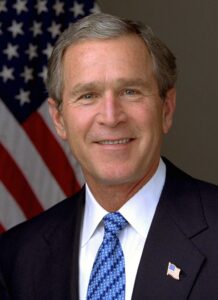
George W. Bush
George W. Bush (born 1946)
- Won the presidency in 2000 after the Supreme Court halted the Florida recount with a 537-vote margin separating him from Al Gore, then saw his approval ratings reach 90 percent following the September 11 attacks — the highest ever recorded for a sitting president — before ordering the invasion of Iraq in March 2003 on the basis of intelligence that proved to be wrong, with no weapons of mass destruction found.1Wikipedia — George W. Bush
- Praised his FEMA director with "Brownie, you're doing a heck of a job" as Hurricane Katrina killed approximately 1,800 people and left New Orleans underwater in August 20052Miller Center — George W. Bush Domestic Affairs — a response later described by Bush himself as a failure of leadership — with the combined effect of Iraq, Katrina and the 2008 financial crisis leaving him with a 22 percent approval rating, among the lowest of any departing president in the modern polling era.1Wikipedia — George W. Bush
- Signed the $700 billion Emergency Economic Stabilization Act in October 2008 to prevent the collapse of the financial system2Miller Center — George W. Bush Domestic Affairs — the direct consequence of a decade of deregulation his administration had championed — and left office in January 2009, subsequently withdrawing almost entirely from public life to take up painting at his ranch in Texas.3History.com — George W. Bush
George W. Bush served as the 43rd President of the United States from 2001 to 2009, leading the country through the most significant foreign policy catastrophe in its post-Cold War history while simultaneously overseeing a domestic agenda that was largely competent and occasionally bold.
Bush came to office in contested circumstances — the 2000 election was decided by the Supreme Court after a 537-vote margin in Florida, giving him a legitimacy deficit that would ordinarily have constrained his first term significantly. It did not, because September 11 intervened.4Britannica — George W. Bush
The attacks of September 11, 2001 transformed Bush's presidency in ways that neither he nor anyone else could have anticipated. His immediate response — the address to Congress, the bullhorn at Ground Zero, the Afghanistan campaign — showed a leader capable of rising to a genuine national emergency. His approval ratings reached 90 percent. His k variable, already negative from the contested election, suddenly reversed. The environment was maximally permissive for executive action.1Wikipedia — George W. Bush
The decision to invade Iraq in 2003 was the hinge on which everything turned. The intelligence was wrong, or rather it was treated as settled when it was contested. The legal basis was thin. The post-invasion planning was catastrophically absent — a vacuum that produced a civil war, the rise of Al-Qaeda in Iraq, and ultimately the conditions that generated ISIS. The Congruence variable — the say-do gap between stated justification and actual intelligence — collapsed permanently in 2004 when no weapons of mass destruction were found.5Britannica — George W. Bush Presidency
Hurricane Katrina in 2005 revealed a different failure — not malice but incompetence. The Federal Emergency Management Agency response was a masterclass in Administrative Impotence. The images of New Orleans underwater while the President praised his FEMA director became one of the defining images of a second term that never recovered its footing. Bush later admitted he should have recognised the deficiencies sooner and intervened faster — an acknowledgement that the Humility variable records but that arrived too late to alter the outcome.2Miller Center — George W. Bush Domestic Affairs
The 2008 financial crisis arrived in the final months of his presidency, the direct consequence of a decade of deregulation that his administration had championed. He left office with approval ratings among the lowest of any departing president in the modern polling era.1Wikipedia — George W. Bush
In Codex terms, Bush presents a leader with moderate personal variables — functional Ability, genuine Conviction, reasonable Process — operating in an environment that swung from maximally permissive after 9/11 to maximally hostile by 2008. The Iraq decision is the Congruence collapse that defines his legacy, just as Iraq defines Blair's. The difference is that Bush had the power to make the decision unilaterally in a way that Blair did not.
Score Comparison
Add up to 10 leaders. Click a name to visit their profile.
The 13 Equations
Scores for: Post 9/11 2001–2003The 22 Variables
Canonical scoresSources & Bibliography
The scores assigned to this leader are derived from publicly available sources. Variable inputs reflect documented behaviour, structural conditions, and historical record at the time of each snapshot.