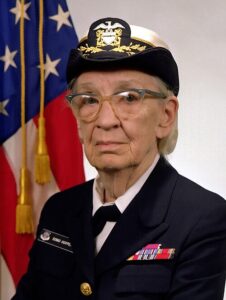
Grace Hopper
Grace Hopper 1906-1992
- Devised the first theory of machine-independent programming languages and led the team that created the first computer compiler at Eckert-Mauchly in 1952 — converting the computer from an instrument requiring expert mathematical fluency into a tool operable by people who could write instructions in ordinary English — a Defined Output that, in COBOL's subsequent deployment as 'the most extensively used computer language in the world' by the 1970s, reached an audience of users that no previous computing tool had approached, and that continues to run an estimated $3 trillion in daily commerce.1Wikipedia — Grace Hopper ↗
- Was recalled to active Naval duty at age sixty after mandatory retirement, assigned to the Chief of Naval Operations' staff as Director of the Navy Programming Languages Group, led the effort to standardise naval computing languages across multiple incompatible systems, developed the Navy's COBOL compiler validation programme — a concept of standards testing that subsequently influenced national and international standards for most programming languages — and remained on active duty for nineteen years, retiring as a Rear Admiral at seventy-nine as the oldest commissioned officer in the US Navy.2Britannica — Grace Hopper ↗
- Spent twenty years actively marketing the case for English-language programming to business managers who were sceptical that computers could operate on anything but numbers, giving up to 300 lectures per year at the height of her advocacy campaign — demonstrating a Visibility and Authority variable combination that extended the reach of her technical contribution through an explicit communication and persuasion strategy, and that is analytically unusual in the Scientific domain where most leaders score low on Visibility relative to their technical achievement.3NWHM — Grace Hopper ↗
Grace Brewster Murray was born on 9 December 1906 in New York City, the eldest of three children, enrolled at Vassar College, graduated Phi Beta Kappa in mathematics and physics in 1928, completed a master's degree at Yale in 1930 and a doctorate in mathematics in 1934 — one of the first women to earn a PhD from Yale — taught mathematics at Vassar until 1943, and joined the United States Naval Reserve at the age of thirty-six to serve her country in the Second World War.1Wikipedia — Grace Hopper ↗ She was assigned to the Bureau of Ordnance Computation Project at Harvard, where she worked on the Mark I mechanical computer. The analytical profile of Grace Hopper in the Scientific domain is distinctive for the combination of technical innovation, institutional persistence and communication strategy that her career represents. Most scientists in the dataset built institutions or made discoveries and then operated within a fairly limited sphere of influence. Hopper built a technical foundation, directed an institutional programme to standardise it, and then spent two decades as a deliberate advocate for its adoption — treating the communication of her technical contribution as a leadership obligation rather than someone else's problem. The compiler development at Eckert-Mauchly in 1949-52 is the foundational technical achievement. Hopper's insight that data processors — who were not mathematicians — should be able to write instructions in English rather than in symbols was resisted by senior colleagues who insisted it was impossible for computers to understand words. She demonstrated that it was possible, wrote the first compiler, and was vindicated. The Conviction variable in this period reflects a leader who maintained a position against expert consensus because she understood the problem from the user's perspective rather than from the programmer's.4Yale CS — Grace Hopper ↗ The naval career, which ran in parallel with her civilian computing work throughout, added an institutional leadership dimension that most technology pioneers do not have. As Director of the Navy Programming Languages Group from 1967, she had staff, budget, authority and a defined mission: standardise the Navy's computing languages across systems that had been developed independently and could not communicate with each other. She achieved this. The compiler validation programme she developed became the model for language standards across the computing industry. The Visibility variable scores at an unusual level for a scientist: Hopper gave 300 lectures a year at the peak of her advocacy, appeared on the CBS 60 Minutes programme, demonstrated nanoseconds to David Letterman on late-night television, and cultivated a public reputation as 'Amazing Grace' — the Rear Admiral who made computers speak English — that served a specific strategic purpose: making business managers comfortable with a technology they feared. The Congruence variable scores at its ceiling: she said COBOL would change how the world operated, and it did. She was the first woman to be named Computer Science Man of the Year (1969), the first individual woman to receive the National Medal of Technology (1991), and received the Presidential Medal of Freedom posthumously in 2016. She died on 1 January 1992, aged eighty-five, and was buried with full military honours at Arlington National Cemetery.
Score Comparison
Add up to 10 leaders. Click a name to visit their profile.
The 13 Equations
Scores for: Naval Computing Standards Director and AdvocacyThe 22 Variables
Canonical scoresWhat changed: First Compiler and COBOL Development → Naval Computing Standards Director and Advocacy
Sources & Bibliography
The scores assigned to this leader are derived from publicly available sources. Variable inputs reflect documented behaviour, structural conditions, and historical record at the time of each snapshot.