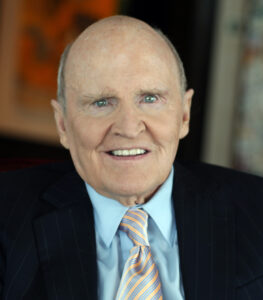
Jack Welch
Jack Welch (1935–2020)
- Born John Francis Welch Jr. on 19 November 1935 in Peabody, Massachusetts — earned a doctorate in chemical engineering from the University of Illinois, joined GE in 1960 as a junior engineer in the plastics department, threatened to resign several times in his early years over the company's bureaucratic inefficiency, was appointed CEO in 1981 at forty-five as the youngest chief executive in GE's history1Wikipedia — Jack Welch — and within three months of taking office announced that every GE business unit must rank first or second in its market or be fixed, sold, or closed: a Defined Output so precise and executable that the organisation could understand and act on it immediately.
- Over twenty years sold more than 200 underperforming business units, eliminated nine layers of management hierarchy, built a rank-and-yank performance architecture that counselled out the bottom ten percent of managers annually, adopted Six Sigma across the entire professional workforce, and grew GE's revenues from $26.8 billion to $130 billion and its market capitalisation from $14 billion to $600 billion1Wikipedia — Jack Welch — while simultaneously shifting the actual engine of that growth from manufacturing and operational excellence to GE Capital, an unregulated financial services operation that by the end of his tenure accounted for 40 percent of the company's revenue and was generating earnings through mechanisms that had nothing to do with Six Sigma or industrial competitiveness.
- Was named Manager of the Century by Fortune in 1999, retired in September 2001 with a severance package of approximately $417 million — the largest in history at the time — handed the organisation to his handpicked successor Jeff Immelt, watched GE's market capitalisation fall from $600 billion to $200 billion over the following two decades, declined to discuss the decline substantively1Wikipedia — Jack Welch — and died on 1 March 2020, aged eighty-four, with his most consequential decisions still being argued over by the business schools that had named buildings after him.
Jack Welch is the dataset's most instructive case study in the difference between reputation and output. He was named Manager of the Century at the precise moment his most consequential decisions were beginning to hollow out the system he had built. The equations do not record his reputation. They record what the variables produced.
The early transformation period is the most defensible phase of his record. The diagnosis was accurate — a sprawling conglomerate organised around bureaucratic inertia rather than competitive position, carrying businesses that had no prospect of market leadership and no coherent reason to exist within the same organisation. The response was brutal but coherent. Eliminating positions, selling underperforming units, and imposing a clear Defined Output — first or second in every market or exit — gave the organisation a direction it could understand and execute against.1Wikipedia — Jack Welch Welch overcame the resulting resistance through Conviction and Autonomy rather than through the kind of cultural engagement that would have lowered it more sustainably. The nickname "Neutron Jack" — eliminating people while leaving buildings standing — was not a criticism. It was an accurate description of the mechanism.
The Process architecture he built was genuine. Six Sigma, the management development system, the rank-and-yank discipline, the elimination of nine layers of hierarchy — these were real operational improvements that produced real results. Where the equations begin to diverge from the public narrative is in the Congruence variable, which tracks the gap between what Welch said the organisation was doing and what it was actually doing. By the peak period, the stated framework — manufacturing excellence, operational rigour, market leadership — was increasingly a description of a company that no longer existed. The actual engine of performance was GE Capital, an unregulated financial services business generating earnings through mechanisms that had nothing to do with Six Sigma or industrial competitiveness. Welch knew this. He did not say it.1Wikipedia — Jack Welch
The Defined Output variable degrades across the three snapshots for the same reason. First or second in every market is a precise destination. Maximising a financial engineering operation disguised as a manufacturing conglomerate is not. By the final snapshot the organisation knew it was being measured on earnings consistency rather than on the stated framework, and it behaved accordingly. The corner-cutting that produced the defence contracting scandals and the Kidder Peabody bond trading scheme were not aberrations from the Welch culture. They were expressions of it.
The Value variable at the final snapshot is the equations' most direct verdict on the Welch legacy. A company that achieved its earnings targets through financial engineering, earnings smoothing, and the systematic transfer of risk to a balance sheet that would collapse in the next crisis delivered less genuine value than its market capitalisation suggested. The equations record that correctly. The market did not — until 2008, when GE Capital was labelled too big to fail and came under Federal Reserve regulation, and the accumulated cost of two decades of structured ambiguity became visible.1Wikipedia — Jack Welch
What the Congruence collapse does not diminish is the genuine management innovation of the early period. The performance management architecture Welch built at GE was adopted across corporate America, and much of it was sound. The problem was not the tools. It was that the tools were eventually deployed in service of an output that contradicted the values they were supposed to enforce. A system built on rigorous measurement of the wrong things produces rigorous achievement of the wrong outcomes. That is what the equations show across the three snapshots: Process remaining high while Value declines, because the process was increasingly directed at a destination that extracted rather than created.
Welch's response to the post-tenure collapse of the organisation he built is itself a variable score. He declined to discuss it substantively, attributed the decline to his successor's decisions and to external events, and maintained publicly that his tenure had been a success measured against his own stated standard. That is Pride operating at its documented maximum — the inability to update a position when the evidence of its consequences is overwhelming and the cost of acknowledgement is reputational. The equations had already recorded it before the evidence was in.
Score Comparison
Add up to 10 leaders. Click a name to visit their profile.
The 13 Equations
Scores for: GE Financial EngineeringThe 22 Variables
Canonical scoresWhat changed: GE Peak → GE Financial Engineering
Sources & Bibliography
The scores assigned to this leader are derived from publicly available sources. Variable inputs reflect documented behaviour, structural conditions, and historical record at the time of each snapshot.