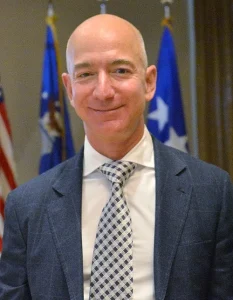
Jeff Bezos
Jeff Bezos (born 1964)
- Born in Albuquerque, New Mexico to a seventeen-year-old mother, adopted at four by a Cuban immigrant who put him through Princeton1Wikipedia — Jeff Bezos — graduated summa cum laude in electrical engineering and computer science, became D.E. Shaw's youngest senior vice-president by thirty, then quit to drive across the country writing a business plan for an online bookstore, founding Amazon in a garage in 1994 and warning early investors there was a 70% chance it would fail.1Wikipedia — Jeff Bezos
- Built Amazon from an online bookstore into the world's largest e-commerce platform, cloud computing infrastructure provider, logistics network and artificial intelligence operation — becoming the world's wealthiest person from 2017 to 20211Wikipedia — Jeff Bezos — while the International Trade Union Confederation named him the World's Worst Boss in 2014, thousands of Amazon workers relied on food stamps and public assistance, and he raised wages to fifteen dollars only after Bernie Sanders introduced a bill named after him.2CNBC — Sanders introduces the Bezos Act
- Stepped down as Amazon CEO in July 2021 after twenty-seven years, flew to space on Blue Origin's New Shepard rocket the same month3EBSCO Research Starters — Jeff Bezos — and as of 2025 holds a net worth of $239 billion while his philanthropy, relative to that wealth, remains the most visible gap between his stated values and his observable behaviour.1Wikipedia — Jeff Bezos
Jeff Bezos was born in 1964 in Albuquerque, New Mexico, to a seventeen-year-old mother and a father who was gone before he was two. His stepfather, a Cuban immigrant who adopted him at four, put him through Princeton.1Wikipedia — Jeff Bezos He graduated summa cum laude in electrical engineering and computer science, became D.E. Shaw's youngest senior vice-president by thirty, then quit to drive across the country writing a business plan for an online bookstore. He founded Amazon in a garage in 1994 and warned early investors there was a 70% chance it would fail.
It did not fail. What followed was one of the most consequential corporate builds in history — from garage bookstore to the world's largest e-commerce platform, cloud computing infrastructure provider, logistics network, and artificial intelligence operation. The method was consistent throughout: scale aggressively, reinvest everything, treat profitability as a future event rather than a present constraint, and never let the organisation mistake comfort for progress. His internal management philosophy — "It is always Day 1" — was not a slogan.4AWS Executive Insights — Day 1 Culture Day 2, he told his staff, was stasis. Day 3 was irrelevance. Day 4 was excruciating decline. Day 5 was death.
His leadership style was data-driven to the point of being clinical. He replaced presentation slides with six-page written narratives read in silence at the start of meetings, enforced a two-pizza rule on team sizes, and built a flywheel model of operational reinforcement that every Amazon manager was expected to understand and articulate.4AWS Executive Insights — Day 1 Culture The International Trade Union Confederation named him the World's Worst Boss in 2014. Harvard Business Review ranked him the best-performing CEO for four consecutive years before dropping him from the top hundred entirely, citing working conditions, employment policies, and data security. The tension between those two verdicts runs through his entire leadership arc — exceptional at building systems, indifferent to the human cost of operating inside them.
The Congruence problem for Bezos is structural rather than episodic. His say-do gap accumulated steadily: a man who speaks of work-life harmony while running warehouses where ambulances waited outside in summer heat; who championed customer obsession while his median worker relied on food stamps; who raised wages to fifteen dollars only after Bernie Sanders introduced a bill named after him.2CNBC — Sanders introduces the Bezos Act None of these are single catastrophic moments. All of them are visible. The equations register the cumulative effect.
His Defined Output is exceptionally high — "Get Big Fast" and "It is always Day 1" are not vague ambitions, they are operational directives that cascade through every layer of the organisation. His Process architecture is among the most sophisticated in the dataset — the flywheel model, the working backwards methodology, the six-pager discipline — these are not management techniques borrowed from others. They were invented at Amazon and they compounded.4AWS Executive Insights — Day 1 Culture
He stepped down as CEO in 2021, transitioning to executive chairman. He has since turned his attention to Blue Origin, artificial intelligence, longevity research through Altos Labs, and Project Prometheus.1Wikipedia — Jeff Bezos His net worth as of 2025 stands at $239 billion. His philanthropy, relative to that wealth, remains the most visible gap between his stated values and his observable behaviour — a man who speaks of preserving Earth for future generations while funding a space tourism company and sitting on one of the largest private fortunes in history.
The equations show a sharp rise through the Amazon Peak snapshot, constrained throughout by Congruence and a Pride score that reflects a man who physically transformed himself into a dominant public symbol, surrounded himself with alignment rather than challenge, and publicly contested every critical article rather than absorbing the criticism. The Post-CEO snapshot shows declining operational variables offset by continued Resource and Recognition strength. The arc is rise, dominance, and an unresolved question about what the last chapter looks like.
Score Comparison
Add up to 10 leaders. Click a name to visit their profile.
The 13 Equations
Scores for: Building Amazon 1994–2010The 22 Variables
Canonical scoresSources & Bibliography
The scores assigned to this leader are derived from publicly available sources. Variable inputs reflect documented behaviour, structural conditions, and historical record at the time of each snapshot.