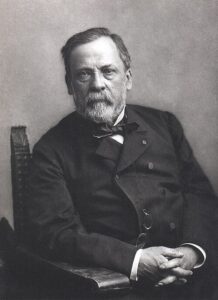
Louis Pasteur
Louis Pasteur 1822-1895
- Founded and directed the Institut Pasteur from its inauguration on 14 November 1888 — built on international charitable donations raised entirely on the basis of his rabies vaccine's public success — gathering scientists from France, Russia, and beyond under a single research programme explicitly designed to convert laboratory microbiology into public health interventions, and establishing an institutional model that now encompasses a global network of thirty institutes across twenty-five countries continuing his stated mission of protecting human health through scientific research.1Institut Pasteur — History ↗
- Conducted and publicly demonstrated the anthrax vaccine trial at Pouilly-le-Fort in May 1881 with a dramatic experimental design — vaccinating one group of sheep and leaving another unvaccinated, then infecting both with virulent anthrax — that converted sceptical veterinary and agricultural audiences into supporters of vaccination as a public health instrument, understanding that the transformation of scientific knowledge into public acceptance required a theatrical Defined Output that the public could witness and verify, not merely a paper they could not read.2Science History Institute — Louis Pasteur ↗
- Established that microorganisms cause disease and fermentation — the germ theory — against the dominant medical consensus of his era, converting chemistry into microbiology through the use of quantitative experimentation more rigorous than any previous practitioner had achieved, and then applying that knowledge to save the French beer, wine and silk industries, to develop vaccines for fowl cholera, anthrax and rabies, and to argue successfully for antiseptic surgical practice — a sequence of outputs spanning commercial, agricultural, medical and scientific domains that no other nineteenth-century scientist approached in breadth.3Britannica — Louis Pasteur ↗
Louis Pasteur was born on 27 December 1822 in Dole, eastern France, the son of a tanner and former soldier, an average student who showed talent for portrait drawing rather than science until his chemistry professor at the Royal College of Besançon recognised his ability and encouraged him to apply to the École Normale Supérieure in Paris.3Britannica — Louis Pasteur ↗ He graduated in 1847, completed his doctorate in 1848 with a fundamental discovery about molecular chirality — that tartaric acid crystals existed in mirror-image forms with different optical properties — and spent the next five decades transforming chemistry, biology, public health and medicine through a sequence of investigations that each began with a practical problem and ended with a fundamental principle. The analytical entry point for Pasteur's profile in the Scientific domain is the relationship between scientific discovery and institutional translation. Most scientists in the dataset made discoveries and hoped others would apply them. Pasteur applied them himself, built institutions to sustain the application, and used public theatre — the Pouilly-le-Fort demonstration, the Meister rabies vaccination, the statistical presentation of mortality data — to convert scientific knowledge into public acceptance and policy change. The Process variable reflects a scientist who understood that the institutional journey from laboratory result to public health outcome was as important as the result itself.2Science History Institute — Pasteur ↗ The Congruence variable carries specific analytical complications. The Pouilly-le-Fort anthrax demonstration was publicly staged as a validation of Pasteur's method, but subsequent historical analysis of his laboratory notebooks revealed that he used a different vaccine preparation than the one he had publicly described — specifically, potassium dichromate to inactivate anthrax spores rather than the attenuated culture method he had claimed. The rabies vaccination of Joseph Meister in 1885 — the nine-year-old boy who had been severely bitten by a rabid dog — was performed without a medical licence, and Pasteur had treated two other patients before Meister without disclosing this. These episodes register in the Congruence variable: not as disqualifying failures but as analytically present discrepancies between stated method and actual practice. The Institut Pasteur, inaugurated in 1888 from international donations raised on the rabies vaccine's success, is the institutional output that most precisely demonstrates his Leadership variable. He designed it to integrate research and medical application in a single institution, invited his principal collaborators to direct its laboratories, and established it as a non-profit foundation explicitly designed to outlast his personal involvement. It has.4PMC — Pasteur Legacy ↗ He suffered a severe stroke in 1868 that left him partially paralysed for the rest of his life. He continued to work. He died on 28 September 1895 and was buried in a vault beneath the Institut Pasteur. The vault is still there.
Score Comparison
Add up to 10 leaders. Click a name to visit their profile.
The 13 Equations
Scores for: Anthrax and Rabies Vaccines — Public ScienceThe 22 Variables
Canonical scoresSources & Bibliography
The scores assigned to this leader are derived from publicly available sources. Variable inputs reflect documented behaviour, structural conditions, and historical record at the time of each snapshot.