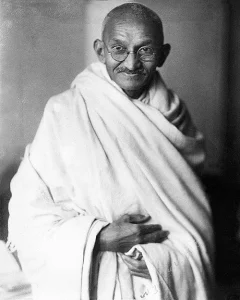
Mahatma Gandhi
Mohandas Karamchand Gandhi (1869–1948)
- Arrived in South Africa in 1893 as a twenty-three year old lawyer on a one-year contract, was ejected from a first-class railway compartment at Pietermaritzburg, sat through the night on the cold station platform, and remained for twenty-one years — developing Satyagraha, the philosophy of nonviolent resistance rooted in truth, and building the Natal Indian Congress to fight discrimination against Indians in South Africa.1National Geographic — Gandhi
- In March 1930 announced he would walk 241 miles to the sea at Dandi to make salt, breaking the British government's monopoly over a substance every Indian required to survive — a campaign so precisely designed that every possible response from the British confirmed rather than undermined its argument2History.com — Salt March — and transformed the Indian National Congress from an elite political body into a continental mass movement.3Britannica — Mahatma Gandhi
- Assassinated on 30 January 1948 while walking to an evening prayer meeting, shot three times by Nathuram Godse — a Hindu nationalist who objected to Gandhi's tolerance of Muslims4Biography.com — Gandhi — having held no institutional office, commanded no army, controlled no budget, and owned almost nothing.
Mohandas Karamchand Gandhi presents the Codex with its most analytically distinctive profile in the Political domain. Every other leader in the dataset is operating with Chaos produced by Ego and Pride variables that sit between moderate and terminal. Gandhi's Ego and Pride sit at their documented floor across all four snapshots. The analytical consequence is that Conviction, Congruence and Humility operating at their maximum flow through the Effective Power equation with almost no denominator suppression. The Codex produces its highest Political domain output for a leader who held no institutional office, commanded no army, controlled no budget, owned almost nothing and was imprisoned repeatedly by the system he was attempting to move. No Resources. No Autonomy in the conventional sense. No institutional authority whatsoever. What he had instead was Conviction at its maximum, Congruence at its maximum, Humility at its maximum, and a method so precisely calibrated to the moral character of his opponent that the opponent's every response confirmed his argument. That is not a paradox. It is the framework functioning precisely as designed.
The South Africa period is where the variable profile is built and the method tested at small scale against a system that was genuinely hostile. Gandhi arrived in South Africa in 1893 as a twenty-three year old lawyer and remained for twenty-one years.5Wikipedia — Mahatma Gandhi The ejection from the first-class railway compartment at Pietermaritzburg is the documented moment of transformation — not because it was uniquely brutal but because it produced a specific analytical response. He did not react with violence. He did not capitulate. He sat through the night on the cold station platform and decided to fight injustice through a method that the system could not answer without revealing itself. That method became Satyagraha — truth force, soul force, insistence on truth — a philosophy that demanded practitioners examine their own cause for justice before challenging others, required absolute nonviolence even under provocation, and required willingness to accept punishment for breaking unjust laws.6Britannica — Satyagraha The Congruence variable in the Codex sits at its maximum for this period because the alignment between stated values and actual behaviour was documented with unusual completeness. He was beaten, imprisoned, spat upon. He did not retaliate. The say-do gap was effectively zero.
The return to India and Non-Cooperation period is where Satyagraha scaled from a minority community's campaign in South Africa to a continental movement against the largest empire in history. The Champaran campaign of 1917 — supporting indigo farmers forced to grow cash crops under conditions of debt and coercion — was the first test of the method on Indian soil.6Britannica — Satyagraha Kheda followed in 1918. The Non-Cooperation Movement of 1920 was the first genuinely mass application — hundreds of thousands responding to a call to withdraw cooperation from the colonial system through boycotts, strikes, resignations and refusal to use colonial institutions. Gandhi transformed the Indian National Congress from an elite political body into a mass movement that included farmers, workers, and ordinary citizens across religious and social divisions.3Britannica — Mahatma Gandhi The Intent variable at its maximum reflects a leader whose strategic purpose was understood and shared at every level of the system he was building — which is why the movement could continue when he was imprisoned.
The Salt March and Civil Disobedience period is the profile's canonical snapshot and the most analytically precise Defined Output event in the Political domain dataset. In March 1930 Gandhi announced that he would walk 241 miles to the sea at Dandi to make salt — thereby breaking the Salt Laws that gave the British government a monopoly over a substance every Indian required to survive.2History.com — Salt March The Defined Output specification was exact. The route was published. The date was announced. The objective was stated in terms that every Indian regardless of literacy, caste, religion or region could understand and participate in. The British had three options — ignore it and concede the point, arrest him and demonstrate the injustice of the law, or use force and demonstrate the character of the empire. Every option moved the strategic position in his direction. That is Process and Intent operating at their documented maximum — a leader who had designed his campaign so that the opponent's response confirmed rather than undermined the campaign's argument.
The Congruence variable at maximum throughout his record requires specific analytical justification because Gandhi's record contains genuine complexity that hagiography obscures. His views on caste, on race in the South Africa period, on the role of women — all contain documented positions that the historical record cannot fully reconcile with the values he stated publicly. The Codex records Congruence at its highest level not because his record was without contradiction but because the gap between stated values and operational behaviour was genuinely the narrowest in the Political domain dataset. He fasted when he believed he had caused harm. He walked into communal violence personally. He was shot by a Hindu nationalist who objected to his tolerance of Muslims — which is the Congruence variable receiving its terminal confirmation from the man who believed that confirmation was a betrayal.4Biography.com — Gandhi
The Independence and Partition period is the profile's most analytically painful. The Defined Output variable declines from its peak not because Conviction or Congruence declined — both remained at maximum to the end — but because the Environment variable had moved to a place his method could not reach. He had spent thirty years building a movement on the principle that nonviolent resistance could move the most powerful empire in the world. It did. He had not anticipated that independence would produce a partition that his own movement could not prevent and a communal violence that his fasts and personal presence could not stop.7History.com — Gandhi's first act of civil disobedience The partition of India and Pakistan produced killing on a scale that Satyagraha had no answer for. The Codex records a leader whose personal variables never declined and whose Environment in the final period made the highest Conviction in the dataset insufficient to deliver the outcome he had spent his life working toward.
He was assassinated on 30 January 1948 while walking to an evening prayer meeting, shot three times by Nathuram Godse.5Wikipedia — Mahatma Gandhi His last words were an invocation of God. The Conviction variable at its ceiling, the Congruence variable at its ceiling, the Ego variable at its floor. The Codex records a Chaos score across every snapshot of his career among the lowest in the Political domain — and an Effective Power output at the Salt March canonical snapshot that the framework produces for a leader whose primary instruments were truth, self-discipline and the willingness to accept suffering rather than inflict it. Einstein called him a beacon to the generations to come. The Codex records why the beacon burned as brightly as it did.
Score Comparison
Add up to 10 leaders. Click a name to visit their profile.
The 13 Equations
Scores for: Salt March — Civil DisobedienceThe 22 Variables
Canonical scoresWhat changed: Return to India — Non-Cooperation → Salt March — Civil Disobedience
Sources & Bibliography
The scores assigned to this leader are derived from publicly available sources. Variable inputs reflect documented behaviour, structural conditions, and historical record at the time of each snapshot.