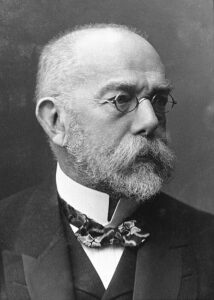
Robert Koch
Robert Koch 1843-1910
- As Director of the Hygienic Institute at Berlin University from 1885 and Director of the Royal Prussian Institute for Infectious Diseases from 1891 — subsequently renamed the Robert Koch Institute — attracted colleagues including Paul Ehrlich, Emil von Behring and Shibasaburo Kitasato who produced at his institute the epoch-making work on diphtheria immunology that led to the Nobel Prizes for Behring and Ehrlich, demonstrating a People variable that operated as a multiplier: the scientific output of the people he recruited and directed exceeded his own individual contribution.1Nobel Prize — Robert Koch ↗
- Formulated Koch's Postulates — four criteria establishing that a specific microorganism causes a specific disease — providing the methodological framework that transformed the relationship between microbiology and medicine from association to causation, and that remains 'the gold standard' of medical microbiology today; his discovery of the tuberculosis bacillus on 24 March 1882, presented to the Berlin Medical Society in a lecture described by contemporaries as 'the most important in medical history', applied these postulates to the disease responsible for one in seven deaths in the German Reich.2RKI — Robert Koch ↗
- Led field investigations of cholera in Egypt and India in 1883-84, identifying Vibrio cholerae as the causative agent and defining the hygienic interventions — water supply, sewage disposal, contact isolation, excreta disinfection — that subsequently contained outbreaks including the Hamburg epidemic of 1892, translating laboratory bacteriology into public health operational protocols with measurable mortality impact and establishing the institutional model for disease outbreak investigation that national public health agencies continue to follow.3RKI — Koch history ↗
Heinrich Hermann Robert Koch was born on 11 December 1843 in Clausthal, the third of thirteen children of a mining engineer, showed a precocious aptitude for science that led him to study medicine at Göttingen under the anatomist Jacob Henle — who had argued as early as 1840 that living parasitic organisms caused contagious disease — and qualified as a physician in 1866.4Wikipedia — Robert Koch ↗ He worked as a district physician in Wollstein, rural Prussia, for seven years, conducting the bacteriological research that would establish his international reputation in a private laboratory he built himself with minimal equipment. The analytical profile of Koch in the Scientific domain is built on a Process variable that changed the field of medicine in a way no previous scientist had achieved. His formulation of Koch's Postulates did not merely describe what he had done; it provided every subsequent scientist with a methodology for establishing causation rather than correlation — a methodological contribution whose value compounds with each generation of scientists who use it. The Defined Output variable in his profile accordingly scores at its ceiling for the Postulates work: the output was not a single finding but a framework that transformed the validity of every subsequent finding made within it. The Berlin period, during which the Hygienic Institute and then the Institute for Infectious Diseases became the international hub for bacteriology, is the clearest expression of the People variable. Koch attracted to his institutes the scientists who would go on to produce Nobel Prize-winning work in immunology — Ehrlich, Behring, Kitasato — and provided the institutional conditions in which that work could be done.1Nobel Prize — Koch ↗ The Institute for Infectious Diseases under Koch's directorship was not merely a laboratory; it was the global training centre for bacteriologists, with scientists from across Europe and beyond seeking appointments there. The tuberculin episode — the 1890 announcement of a supposed remedy for tuberculosis that proved ineffective and caused deaths in some patients — is the most significant Congruence complication in Koch's profile. He announced tuberculin at the Tenth International Medical Congress in Berlin with claims he could not substantiate, withheld the preparation method in a manner that prevented independent verification, and was subsequently shown to have been motivated at least partly by the prospect of establishing his own independent institute using tuberculin revenues. The German government's 1891 report declaring tuberculosis uncurable by tuberculin, and Virchow's autopsy findings showing deaths among treated patients, were serious professional blows that the equations register in the Congruence variable. He received the Nobel Prize in Physiology or Medicine in 1905 for his tuberculosis research. He died on 27 May 1910 in Baden-Baden. World Tuberculosis Day is observed on 24 March each year — the anniversary of his 1882 announcement of the tuberculosis bacillus.
Score Comparison
Add up to 10 leaders. Click a name to visit their profile.
The 13 Equations
Scores for: Institute for Infectious Diseases — DirectorThe 22 Variables
Canonical scoresWhat changed: Discovery of Tuberculosis Bacillus and Koch's Postulates → Institute for Infectious Diseases — Director
Sources & Bibliography
The scores assigned to this leader are derived from publicly available sources. Variable inputs reflect documented behaviour, structural conditions, and historical record at the time of each snapshot.