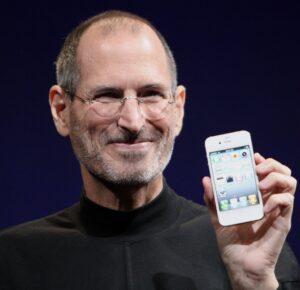
Steve Jobs
Steve Jobs (1955–2011)
- Co-founded Apple in 1976 with Steve Wozniak, launched the Macintosh in 1984, then was stripped of his operating role and resigned in 1985 following a power struggle with CEO John Sculley — going on to found NeXT, acquire Pixar from Lucasfilm for under $10 million, and watch Pixar produce the first full-length computer-animated feature film in 1995.1Wikipedia — Steve Jobs
- Returned to Apple in 1997 when the company bought NeXT for $429 million and was on the verge of bankruptcy — immediately eliminated 70% of product lines, negotiated a $150 million investment from Microsoft, launched the iMac in 1998, and over the following decade introduced the iPod, iPhone and iPad.2Britannica — Steve Jobs
- Diagnosed with pancreatic cancer in 2003, resisted surgery for nine months in favour of alternative treatments — a decision his biographer Walter Isaacson reported he later regretted — resigned as CEO in August 2011, and died two months later aged 56, having built Apple into the world's most valuable company.1Wikipedia — Steve Jobs
Steve Jobs is the dataset's most dramatic redemption arc and its most instructive lesson in what Chaos actually costs a system. The trajectory from the First Apple Era to the iPhone Era is not a story of consistent genius. It is a story of exceptional raw variables being systematically destroyed by internal friction, then rebuilt — partially — into something that could finally convert them into outcomes.
The First Apple Era score will surprise anyone who considers the Macintosh a triumph. The equations do not score the product. They score the system that produced it and then destroyed itself in the same motion. Conviction and Ambition were operating inside a Chaos level that no organisation could sustain indefinitely. The board did not eject him arbitrarily.2Britannica — Steve Jobs The system produced its own correction, because a leader whose Ego and Pride sat at their documented maximum was generating internal friction that consumed his own exceptional force before it could fully reach the output. The Macintosh was completed despite the system, not because of it.
The wilderness period is where the equations record something the standard narrative consistently undervalues. Stripped of institutional resources, Recognition collapsed, and operating without the amplification of an established brand, the variables that remained were the ones that were genuinely his. Conviction held. Ability held. Humility — measurably, documentably — increased. The external pressure of repeated commercial failure at NeXT did what success never could: it forced some updating. Tim Cook later observed that one of the most underappreciated things about Jobs was his ability to change his mind — more so than anyone Cook had ever met.3Apple Wiki — Steve Jobs The Pixar contribution is recorded in the equations honestly — that outcome was not primarily a function of his leadership, it was a function of exceptional talent he had the wisdom to acquire and the restraint to leave largely alone. The equations record both the constraint and the fortune correctly.
The return to Apple is analytically the most interesting snapshot because it shows what a partially corrected Jobs could do against severe inherited resistance. Corporate Drag at this period was genuinely high — the organisation had spent over a decade developing antibodies against exactly his kind of leadership, and those antibodies were not irrational given what they remembered. That he overcame that resistance through Conviction and a precise Defined Output rather than through the kind of identity-driven dominance that had characterised the first era is the measurable difference between the two periods. Humility had not disappeared — it had stabilised at a level that allowed him to hear accurate information about what the system needed without experiencing it as an attack.1Wikipedia — Steve Jobs
The iPhone Era peak is what happens when the corrected variables operate in a favourable environment with sufficient Resources and exceptional talent around them. Chaos is lower than at any previous point in his record — not low, but lower. The numerators are at or near their maximum. The Environment and k variables record that the timing of the iPhone launch relative to network capability and consumer readiness was not entirely within his control.2Britannica — Steve Jobs He deserves credit for the vision. He does not deserve credit for the infrastructure that made it viable, and the equations correctly separate the two contributions.
The score that will generate the most debate is not the iPhone Era peak. It is the First Apple Era. The objection will be that a leader who produced the Macintosh cannot sit at a low score. The response is that the equations are not scoring the product. They are scoring the leadership system — and the leadership system at that period produced a product and then produced its own ejection from the organisation that made it. That is precisely what a low score means. The product survived. The system did not.
What the full four-snapshot trajectory records is that Jobs became a significantly better leader after failing catastrophically than he ever was before succeeding. That is not a common finding in the dataset. It may be the most important thing the equations say about him.
Score Comparison
Add up to 10 leaders. Click a name to visit their profile.
The 13 Equations
Scores for: NeXT / PixarThe 22 Variables
Canonical scoresWhat changed: First Apple Era → NeXT / Pixar
Sources & Bibliography
The scores assigned to this leader are derived from publicly available sources. Variable inputs reflect documented behaviour, structural conditions, and historical record at the time of each snapshot.