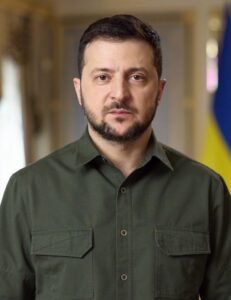
Volodymyr Zelensky
Volodymyr Zelensky (born 1978)
- Born in Kryvyi Rih, southern Ukraine, to a Jewish family whose grandfather was the only one of four brothers to survive the Nazi occupation of Ukraine1Philadelphia Inquirer — Zelensky profile — formed a comedy troupe at university, created and starred in the television series Servant of the People in which he played an ordinary schoolteacher who accidentally becomes president, and in April 2019 won the Ukrainian presidency with 73 percent of the vote against the incumbent having never previously held elected office.
- On 24 February 2022, Russia launched a full-scale invasion — Zelensky introduced martial law, refused the American offer of evacuation with "The fight is here; I need ammunition, not a ride," posted a video of himself standing in the dark outside the presidency building with his top advisers saying simply "We are here"2CNN — Zelensky four years of war — then addressed the UK Parliament, US Congress, and dozens of other legislatures in an unprecedented diplomatic mobilisation that secured billions in military and financial support and transformed the international response to the war.
- Ukrainian forces retook Kherson in November 2022, the only regional capital Russia had captured, then launched a surprise incursion into Russia's Kursk region in August 2024 that briefly shifted the strategic picture2CNN — Zelensky four years of war — before in February 2025 an Oval Office meeting with Trump and Vance became a globally broadcast confrontation in which planned discussions and lunch were cancelled and Zelensky was effectively ejected, the Trump administration briefly suspending military aid before resuming it after Zelensky agreed to a conditional ceasefire proposal that Russia did not accept.
Volodymyr Zelensky became President of Ukraine in 2019, having built his public profile as an actor, comedian and producer — most notably as the star of Servant of the People, in which he played an ordinary schoolteacher who accidentally becomes president. Life imitated art in the most dramatic way possible.
His early presidency was largely unremarkable. Elected on a landslide anti-corruption platform with 73% of the vote, he struggled to deliver. Parliament resisted his agenda, oligarchs retained their grip on media and industry, and his approval ratings fell sharply.3Britannica — Volodymyr Zelensky Through the Codex lens, his pre-invasion score reflects the evidence precisely. Charisma without institutional weight. Management built from political outsiders who had never governed. Promises unmade.
On 24 February 2022, Russia launched a full-scale invasion of Ukraine. In the hours that followed, Western governments offered Zelensky evacuation. His response — "I need ammunition, not a ride" — became one of the defining statements of 21st-century leadership. He stayed in Kyiv, appeared on video from the streets of the capital, and transformed both himself and the war effort entirely.4EBSCO Research Starters — Volodymyr Zelensky
The gap between his pre-war and wartime scores is not a correction. Both are accurate. They measured different men in different environments — and that is precisely what the Codex is designed to do.
Zelensky operates in the most extreme leadership environment measurable by the Codex — existential threat to national survival, resource constraints, international dependency, and the full weight of information warfare. What he provided was narrative coherence and personal visibility at a moment when both were decisive. His Charisma and Influence scores reflect something rare — a leader whose personal presence measurably altered the behaviour of allied governments across dozens of countries.5Al Jazeera — Zelensky profile 2025 His Management and Trust scores reflect the harder reality: wartime governance is imperfect, corruption remains a structural problem — most visibly in the July 2025 anti-corruption watchdog controversy that forced him into a public reversal after rare street protests — and the gap between his public performance and institutional delivery is real.6Wikipedia — Volodymyr Zelensky
His relationship with the Trump administration in 2025 represents the most severe test of the Environment variable in his profile. A leader who had mastered the communication codes of European liberal democracy found himself navigating a counterpart whose operating logic was structurally different. The Oval Office confrontation in February 2025 was the system failing visibly. The subsequent adaptation — finding ways to communicate with Trump through different channels — is the Management variable attempting to correct in real time.
Score Comparison
Add up to 10 leaders. Click a name to visit their profile.
The 13 Equations
Scores for: Pre-Invasion PresidencyThe 22 Variables
Canonical scoresSources & Bibliography
The scores assigned to this leader are derived from publicly available sources. Variable inputs reflect documented behaviour, structural conditions, and historical record at the time of each snapshot.