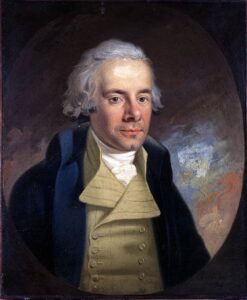
William Wilberforce
William Wilberforce (1759–1833)
- William Wilberforce — son of a Hull merchant, St John's College Cambridge where he formed the friendship with William Pitt the Younger that shaped his entire political career, MP for Hull from 1780 and for Yorkshire from 1784, evangelical Christian convert whose 1785 spiritual transformation redirected his considerable political capability from personal advancement to moral reform, leader of the parliamentary campaign against the slave trade from 1787 to 1807, founder member of the Society for Effecting the Abolition of the Slave Trade, co-founder of the Sierra Leone Company, and the most consequential single-issue parliamentary campaigner in British political history — died three days after hearing that the Slavery Abolition Act had passed its third reading in the Commons, having spent forty-six years pursuing the complete abolition of an institution whose economic interests he understood, whose political opposition he had measured, and whose moral indefensibility he never doubted.1Britannica — William Wilberforce
- His parliamentary campaign produced the Slave Trade Act of 1807 — abolishing the British slave trade after twenty years of sustained parliamentary effort, eleven defeats, and the mobilisation of public opinion through petition campaigns, published testimonies, and the Wedgwood medallion that made the abolitionist image the most widely recognised political symbol of its era — and his subsequent advocacy through the Anti-Slavery Society contributed directly to the Slavery Abolition Act of 1833, which ended legal slavery across the British Empire and for which he did not live to receive official credit, dying four days before it received royal assent.2UK Parliament — Abolition of Slavery
- The private record of a man whose evangelical faith was the organising principle of his political life rather than its rhetorical decoration, whose Practical View of Christianity — arguing that nominal Christianity was insufficient and that genuine faith required active moral engagement with the world — became one of the most widely read religious texts of the early nineteenth century, and whose personal life combined genuine Christian charity with the social conservatism of the Clapham Sect that modern assessments have found analytically complicated — is the most complete illustration in the British Political domain of a leader whose Congruence between private faith and public action was the structural foundation of everything he achieved.3Wilberforce Institute — About Wilberforce
William Wilberforce is the benchmark profile in the British Reform domain and the most complete illustration in the dataset of what sustained single-issue advocacy produces when the Conviction variable operates at its absolute ceiling across a forty-six-year arc. He did not hold executive power. He did not command a parliamentary majority. He operated within an institution designed by and for the economic interests that his cause directly threatened, and he produced the most consequential moral legislative outcome in British parliamentary history through the specific combination of Conviction, Process, Communication, and the People network of the Clapham Sect that no comparable advocate in the dataset has replicated.
The formation period is defined by the specific combination of Hull merchant wealth, Cambridge friendship with Pitt, and evangelical conversion that redirected a career trajectory pointing toward conventional political advancement into the channel that produced the abolition campaign. Wilberforce's Cambridge years — where he formed the friendship with William Pitt that gave him access to the Prime Minister's ear throughout the most critical years of the abolition campaign — are the People variable being built at its most consequential single relationship.1Britannica — William Wilberforce The friendship was genuine — Pitt supported abolition personally and used his political position to advance it when the political conditions permitted — and its value to the campaign was structural: Wilberforce had a direct line to the Prime Minister that no other advocate of any reform in the period possessed. The evangelical conversion of 1785 is the Conviction variable reaching its operational level — not the beginning of moral concern, which Wilberforce had displayed earlier, but the theological framework that gave moral concern the certainty and the stamina that the subsequent forty-six years required.
The campaign's organisational structure — the Society for Effecting the Abolition of the Slave Trade, founded in 1787, with Thomas Clarkson as the primary researcher and evidence gatherer, Granville Sharp as the legal architect, and Wilberforce as the parliamentary face — is the People variable at its most analytically precise expression in the Reform domain.4History.com — Slavery Abolition Wilberforce understood from the outset that the campaign required a division of labour between the parliamentary advocacy that his position made possible and the extra-parliamentary organisation that Clarkson's energy and Sharp's legal expertise could provide. The Process variable in the campaign reflects this understanding — the petition campaigns, the published testimonies, the Wedgwood medallion, the boycott of slave-grown sugar — were designed as coordinated instruments of public opinion formation that the parliamentary campaign required as its operating environment. No previous parliamentary reform campaign had constructed a comparable extra-parliamentary organisational structure to create the political conditions for legislative change.
The first Commons debate of 1789 is the most analytically significant single parliamentary event of the campaign and the one that most precisely captures the Communication variable at its highest parliamentary expression. Wilberforce's three-and-a-half-hour speech — presenting the evidence of the slave trade's operation, the mortality statistics, the eyewitness accounts, and the moral argument against the institution — was acknowledged by opponents and supporters alike as the most powerful parliamentary speech of its generation.1Britannica — William Wilberforce Pitt told him that no minister had ever equalled it. Fox and Burke acknowledged its force from the opposition benches. The bill was defeated anyway — by the economic interests of the West India lobby, the wartime suspension of reform that the Revolutionary Wars produced, and the political calculation that abolition would encourage slave rebellion in the Caribbean — but the Communication variable had established the moral and evidentiary framework that every subsequent debate was conducted within. From 1789 onwards, the slave trade's defenders were arguing on ground that Wilberforce had chosen and prepared.
The eleven defeats between 1791 and 1806 are the Resilience variable's most sustained expression in the British Reform domain. Each defeat was produced by a different combination of factors — wartime emergency, West India lobby pressure, the Saint-Domingue rebellion's impact on parliamentary anxiety about slave uprisings, the Pitt government's need for West Indian sugar revenues — and each required Wilberforce to assess the specific reason for the defeat, adjust the campaign's timing and approach, and return in the following session with the same commitment and a more precisely calibrated strategy.2UK Parliament — Abolition of Slavery The Learning variable across this period is the most analytically significant in the profile — Wilberforce updated the campaign's strategy, its evidence base, its parliamentary timing, and its public communication in response to each defeat without updating the Conviction that the cause was right. That combination — empirical Learning about method, absolute Conviction about objective — is the analytical foundation of the eventual success.
The Slave Trade Act of 1807 is the canonical snapshot and the most analytically consequential legislative output of the campaign. The specific tactical decision that produced it — focusing the final campaign on the Foreign Slave Trade rather than the British Slave Trade, removing the economic interests of the most powerful West Indian lobby members from the bill's direct impact — reflects a Process variable operating at its most sophisticated parliamentary expression.5Britannica — Slave Trade Abolition Act The 1807 parliamentary context — the Fox-Grenville ministry, the death of Pitt removing his complicating influence, and the specific parliamentary arithmetic that the new government produced — reflects the k variable operating at its most favourable point in the campaign: the right parliamentary majority at the right moment after twenty years of preparation. The bill passed the Commons by 283 votes to 16. The Communication, Process, People, and Resilience variables had created the conditions in which the favourable k could be converted into legislative output.
The post-1807 campaign for complete emancipation — conducted through the Anti-Slavery Society from 1823 onwards, after Wilberforce's health prevented continued parliamentary leadership — reflects the same variable profile operating within reduced Autonomy and Resources constraints.3Wilberforce Institute — About Wilberforce Wilberforce handed the parliamentary leadership to Thomas Fowell Buxton in 1825, maintaining public advocacy and the moral authority of his name as the campaign's most recognisable instrument while his physical decline prevented direct parliamentary participation. The Value variable at this snapshot reflects a leader who understood that the cause's institutional requirements had exceeded his personal capacity to deliver them, and who made the People decision to transfer parliamentary leadership to a capable successor without the ego investment in continued personal prominence that most leaders of equivalent stature would have maintained.
The Practical View of Christianity — published in 1797 and reaching its fifteenth edition by 1826 — is the Vision variable's most institutionally significant non-parliamentary output and the one whose influence on the Clapham Sect's broader moral reform agenda extended the campaign's social impact beyond the specific abolition objective.1Britannica — William Wilberforce Wilberforce's argument — that genuine Christian faith required active moral engagement with the world's injustices rather than the nominal observance of social convention — provided the theological framework for the entire Clapham Sect's programme of social reform, from prison reform through missionary education to the Society for the Prevention of Cruelty to Animals. The Communication variable at this snapshot reflects a leader who understood that the parliamentary campaign required a broader cultural transformation of what evangelical Christianity meant in practice, and who produced the defining text of that transformation.
The social conservatism of the Clapham Sect — including Wilberforce's support for the Combination Acts restricting trade union organisation, his limited engagement with domestic labour exploitation compared to his campaigning intensity against chattel slavery, and the paternalistic character of the Sierra Leone resettlement project — requires explicit treatment in the Congruence variable. The gap between the moral framework that made chattel slavery indefensible and the moral framework that accepted the conditions of early industrial labour is analytically real and the score reflects it without erasing the abolitionist achievement.6Oxford DNB — William Wilberforce Wilberforce's Congruence operated within the specific moral boundaries that his evangelical framework defined — and the boundaries themselves were wider than his contemporaries' but narrower than the framework's own internal logic required.
The number that matters most across all four snapshots is Conviction — sustained at its absolute ceiling across forty-six years, through eleven parliamentary defeats, through the wartime suspension of reform, through the physical decline that removed him from parliamentary leadership, and through the final months in which he knew the Slavery Abolition Act was progressing through Parliament but could not know whether he would live to see it pass. A Conviction variable that holds at 10 for forty-six years without the institutional power, the parliamentary majority, or the political class consensus that would have made it easier is the rarest score in the British Reform domain. It is the analytical foundation of everything else in the profile, and it is the reason that the MP for Yorkshire who never held cabinet office produced the most consequential moral legislative outcome in British parliamentary history. That is the Leaderment profile of William Wilberforce.
Score Comparison
Add up to 10 leaders. Click a name to visit their profile.
The 13 Equations
Scores for: Campaign Launch — 1789 Commons Speech and Early DefeatsThe 22 Variables
Canonical scoresSources & Bibliography
The scores assigned to this leader are derived from publicly available sources. Variable inputs reflect documented behaviour, structural conditions, and historical record at the time of each snapshot.