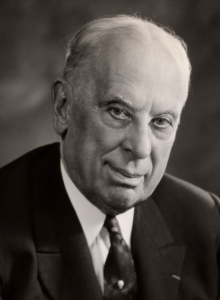
Alfred P. Sloan
Alfred P. Sloan (1875–1966)
- Born on 23 May 1875 in New Haven, Connecticut — studied electrical engineering at MIT, graduating in 1895, took over the failing Hyatt Roller Bearing Company in 1899 at twenty-three, built it into a profitable precision supplier whose bearing design found its way into vehicles across the industry1Britannica — Alfred P. Sloan — sold it to General Motors in 1916 for $13.5 million, entered GM as a vice-president, watched William Durant destroy the company's coherence through intuition-based management, nearly resigned in 1920, and in 1923 became GM's president with a precise theory of how organisations fail and how measurement prevents it.
- Imposed on GM a divisional architecture — Chevrolet, Pontiac, Oldsmobile, Buick, Cadillac in ascending price brackets, each semi-autonomous, each reporting through unified financial controls — and invented the annual model change and the auto loan through the General Motors Acceptance Corporation, driving Ford from industry leadership by the early 1930s and building GM into the largest industrial enterprise the world had ever seen2Wikipedia — Alfred P. Sloan — while simultaneously building an internal espionage apparatus to monitor union activity, and in August 1938 overseeing a GM senior executive's receipt of the Grand Cross of the German Eagle from the Reich, with Nazi armaments chief Albert Speer later telling congressional investigators that Germany could not have executed the 1939 invasion of Poland without technology provided by Sloan and General Motors.
- Responded to a concerned shareholder's 1939 letter by writing that the manner in which the Nazi government ran Germany should not be considered the business of GM's management2Wikipedia — Alfred P. Sloan — retired as GM chairman in 1956 with the company holding 52 percent of the US automobile market, up from 12 percent when he took charge — established the Alfred P. Sloan Foundation in 1934, endowed the Sloan School of Management at MIT, created the Sloan-Kettering Cancer Center, and died on 17 February 1966 aged ninety, having spent the intervening years declining to take Peter Drucker's advice at the lunches at which he listened to it carefully twice a year for two decades.
Alfred Sloan did not found General Motors, and he did not build it through inspiration. He inherited a sprawling, poorly coordinated collection of car companies and imposed upon it an architecture — a precise, replicable structure of divisional autonomy, financial controls, and brand hierarchy — that transformed it into the largest industrial enterprise the world had ever seen. That achievement is real, documented, and lasting. So is the cost of how he got there.
Sloan came to GM via Hyatt Roller Bearing, a manufacturer he took over in 1899 when the company was struggling and built into a profitable, widely-used supplier whose innovative bearing design found its way into vehicles across the industry. The experience gave him something more valuable than capital: a working theory of how organisations fail and how measurement prevents it. When he became GM's president in 1923, he applied that theory at scale.3EBSCO Research Starters — Alfred P. Sloan
The system he constructed was genuinely novel. He divided GM into semi-autonomous divisions — Chevrolet, Pontiac, Oldsmobile, Buick, Cadillac — each competing in a distinct price bracket, each reporting through a unified financial control structure built around return on investment. Buyers could move up the ladder as their prosperity grew without leaving the GM family. The annual model change created perpetual demand. The General Motors Acceptance Corporation invented the auto loan, allowing consumers to bypass years of saving and purchase on credit. Ford, wedded to the Model T and resistant to change, ceded industry leadership to GM by the early 1930s and never fully recovered it. Peter Drucker studied Sloan's system during the war and wrote a book about it. The divisional management structure he pioneered became the default template for large corporations for half a century.1Britannica — Alfred P. Sloan
The critique that accompanied that achievement was equally well-documented. Sloan built an organisation that paid close attention to policies, systems, and structures, and almost none to people, principles, or values. Employees were variables. Society was an externality. When workers organised the Flint sit-down strike in 1936, Sloan's first instinct had been industrial espionage — an internal surveillance apparatus monitoring union activity. The strike succeeded anyway, legitimising the United Auto Workers as GM's bargaining representative.2Wikipedia — Alfred P. Sloan Sloan resented the outcome but accepted it. He preferred, as one account noted, the cold language of the engineer: economising, utility, facts, objectivity, systems, rationality, maximising. Freedom, community, and human dignity did not feature in his vocabulary or his management.
The Nazi collaboration is not ambiguous. In 1938, a senior GM executive received the Grand Cross of the German Eagle from the Reich. GM's Opel facilities produced bombers, trucks, land mines, and torpedo detonators for Nazi Germany throughout the war. Albert Speer later told investigators that Germany could not have executed the 1939 invasion of Poland without technology provided by GM. When a shareholder raised concerns in 1939, Sloan replied in writing that the manner in which the Nazi government ran Germany should not be considered the business of GM's management. He defended the investment as highly profitable. Sloan's memoir presented Opel as effectively nationalised and beyond GM's control. The historical record does not support that account.2Wikipedia — Alfred P. Sloan
Drucker, who spent the war years studying GM at close quarters, drew conclusions that Sloan never accepted. When Sloan's colleagues attacked Drucker in a meeting, Sloan defended his right to be wrong. Then he invited Drucker to lunch once or twice a year for the next twenty years, listened carefully to his views, and never once took his advice. History, Drucker observed, eventually sided with him.
In retirement, Sloan's philanthropic record was genuine and substantial. The Alfred P. Sloan Foundation, established in 1934, funded the world's first university-based executive education programme, endowed the Sloan School of Management at MIT, established hospital administration programmes at Cornell, and created the Sloan-Kettering Cancer Center. He also, correctly and against prevailing Keynesian consensus, predicted the postwar economic boom — pointing to workers' savings and pent-up demand when most economists were forecasting a return to depression.2Wikipedia — Alfred P. Sloan
What the equations capture about Sloan is precise: exceptional process, exceptional resources, exceptional recognition — and a Congruence score that reflects a man who built one of the greatest management systems in industrial history while treating human beings, whether workers on a factory floor or civilians under occupation, as figures in a ledger. The philanthropy is real. So is the shareholder letter.
Score Comparison
Add up to 10 leaders. Click a name to visit their profile.
The 13 Equations
Scores for: Rise at GM (1916–1922)The 22 Variables
Canonical scoresSources & Bibliography
The scores assigned to this leader are derived from publicly available sources. Variable inputs reflect documented behaviour, structural conditions, and historical record at the time of each snapshot.