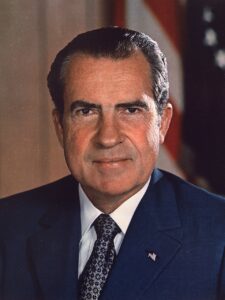
Richard Nixon
Richard Nixon (1913–1994)
- Born in Yorba Linda, California, to a poor Quaker family, graduated from Whittier College and Duke Law School, built his early political reputation on the investigation of Alger Hiss, lost the presidency to Kennedy by the narrowest margin in 1960, was humiliated in the 1962 California gubernatorial election, then rebuilt his political base over six years to win the presidency in 19681Wikipedia — Richard Nixon — demonstrating a Conviction and resilience that his later conduct would comprehensively undermine.
- Made a historic visit to China in February 1972, establishing formal diplomatic relations with the People's Republic for the first time and fundamentally restructuring Cold War geopolitics2Britannica — Richard Nixon — then won re-election in November 1972 by one of the largest landslides in American presidential history, carrying 49 states and 61 percent of the popular vote, while his operatives had already been arrested breaking into Democratic Party headquarters at the Watergate complex five months earlier.
- Released the "Smoking Gun" tape on 5 August 1974 — showing he had ordered the CIA to obstruct the FBI's Watergate investigation — watched his remaining Congressional support collapse within days, and resigned on 9 August 1974, the only president in American history to do so3Wikipedia — Watergate scandal — pardoned by Gerald Ford a month later, and spent the remaining twenty years of his life writing and undertaking foreign trips, attending his state funeral in April 1994 with all five living presidents present.
Richard Nixon served as the 37th President of the United States from 1969 to 1974, resigning before certain impeachment — the only president in American history to do so. His career presents one of the most extreme analytical contrasts in the Codex dataset: foreign policy variables that were genuinely world-historical in their impact, destroyed by character variables that were present from the beginning and catastrophic at the end.
Nixon came to the presidency after one of the most remarkable political comebacks in American history. Defeated by Kennedy in 1960 and humiliated in the 1962 California gubernatorial election — telling reporters "you won't have Nixon to kick around anymore" — he rebuilt his political base over six years and won the presidency in 1968 in a country torn apart by Vietnam, assassination, and civil unrest.4Nixon Foundation — Watergate Explained The comeback itself demonstrated exceptional Conviction and Resilience variables that his later conduct would comprehensively undermine.
The foreign policy record is the most consequential of any post-war American president with the possible exception of Truman. The opening of China in 1972 was a strategic masterstroke — a move so counterintuitive that only a president with Nixon's anti-communist credentials could have executed it without destroying himself domestically. Détente with the Soviet Union, the SALT I treaty, and the fundamental restructuring of the Cold War balance of power represented genuine Transformational leadership in the foreign policy domain.2Britannica — Richard Nixon Henry Kissinger was the instrument but Nixon was the architect.
Vietnam was the shadow over everything. Nixon inherited a war he had not started and could not end cleanly. The secret bombing of Cambodia, the Kent State killings, the draft lottery — these generated a domestic opposition that consumed enormous political energy and suppressed variables that would otherwise have been very high. He did eventually extract the United States from Vietnam through the Paris Peace Accords in 1973, but at a cost in domestic trust and international credibility that permanently damaged his Congruence variable.
Watergate was not a single event — it was the inevitable consequence of a character architecture that had been present throughout. The enemies lists. The wiretapping of journalists and his own staff. The paranoia that ran through every decision like a fault line. Watergate was the moment that architecture became visible to everyone simultaneously.5Britannica — Nixon Watergate The break-in itself was trivial. The cover-up was the presidency-ending decision — a Congruence collapse so complete that even his most loyal supporters could not defend it once the tapes were released.
He resigned on 9 August 1974, in a speech that showed more dignity than his conduct had warranted. Gerald Ford pardoned him a month later. He spent the remaining twenty years of his life attempting to rehabilitate his reputation as a foreign policy elder statesman — with partial success. By the time he died in 1994 he had recovered enough standing to receive a state funeral attended by all five living presidents.1Wikipedia — Richard Nixon
In Codex terms Nixon is the clearest illustration of what happens when Pride and Ego variables reach pathological levels in a leader who simultaneously possesses genuine Ability and Conviction. The foreign policy variables were world-class. The character variables were structurally catastrophic. The equations correctly separate these two realities — which is why his Opening China snapshot scores meaningfully above zero while Watergate scores zero.
Score Comparison
Add up to 10 leaders. Click a name to visit their profile.
The 13 Equations
Scores for: Second Term — Watergate 1973–1974The 22 Variables
Canonical scoresWhat changed: First Term 1969–1972 → Second Term — Watergate 1973–1974
Sources & Bibliography
The scores assigned to this leader are derived from publicly available sources. Variable inputs reflect documented behaviour, structural conditions, and historical record at the time of each snapshot.