Quote from Tom Peters
In 1991, during the first Gulf War, HMS Ark Royal was working the Mediterranean — air cover, deterrence, and reminding various interested parties that presence still matters. When the conflict ended we were granted port time, and our first stop was Athens. I was a newly commissioned Sub-Lieutenant, still under training, but already beginning to suspect that rank and Leadership are not the same thing.
An aircraft carrier does not simply drop anchor. An anchorage is a major maritime evolution — tide, wind, seabed, swing room, water depth, timing — and ours was to be conducted as a training exercise. Every Officer Under Training produced a full anchorage plan. Somewhat to my surprise, mine was selected. I was told to report to the bridge at 0400.
Waiting for me was the First Lieutenant.
The title is a job, not a rank—a distinction that confuses civilians and, occasionally, junior officers. Ours was a Lieutenant Commander, and of a particular vintage: what the Navy calls “stood over.” Having missed his three windows for promotion, his career path was locked. He had nothing left to prove, nothing left to lose, and absolutely no interest in playing to the gallery. Because he could neither be easily promoted nor easily removed, he occupied a rare pocket of independence.
That kind of unmoored security usually produces one of two outcomes: a bitter officer with a chip on his shoulder, or a rare breed who accepts his lot, drawing from his seniority a quiet, unshakeable competence. Ours was the latter.
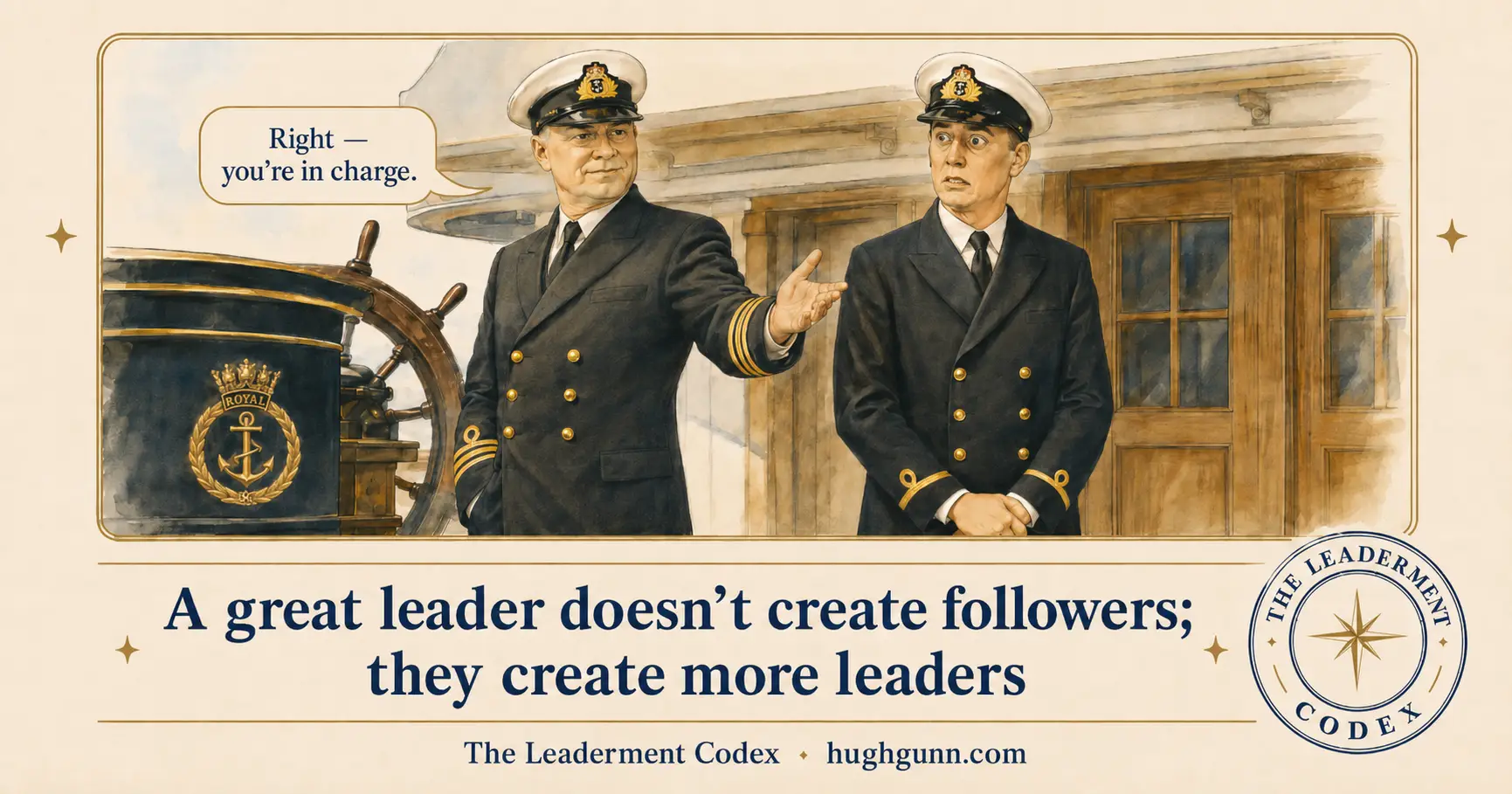
When I arrived, he said simply, “Right then, Sub-Lieutenant. You’re in charge.”
It was, of course, a polite fiction. He was the one actually responsible. But he wanted me to feel command. Every course change, every instruction, he murmured to me first — “You’ll want to come left five degrees now” — and I would call it out to the Officer of the Watch (him). He would repeat the order with an ‘Aye, Sir’. He never took credit. He never corrected me publicly. He never once made it about him. He made the system work through me. A lesson I will never forget.
By the time the ship was anchored, the evolution had gone flawlessly. The plan had worked — but more importantly, so had the people. Later that morning, over a mug of tea, I asked him why he didn’t leave and do something else. He shrugged. “Because I’m good at this job. I pick my own routine, I manage my own time, and no one messes with me — not even the Captain.”
He had found peace in competence, which is rarer than most people think. Not ambition disguised as drive. Not fear disguised as humility. Purpose without politics.
Run him through the Charisma equation, and the math tells a fascinating story:
| Charisma = | Confidence × Ego |
| Humility |
His Confidence was absolute—earned over decades, never performed. His Ego sat near its floor, while his Humility was the largest value on the bridge. Mathematically, this drops his Charisma score close to its floor — the bottom of the scale.
But low Charisma does not mean invisible. In fact, his presence was commanding, though never intimidating. While other “in-zone” officers pushed themselves forward, desperate to impress the Captain—a strategy that invariably backfired—he stood entirely apart from the theatre.
You didn’t look past him; you looked to him. You actively wanted to please him, to earn a nod of acknowledgement from a man who had zero interest in selling himself. The equation hasn’t failed; it has simply isolated the truth. Charisma is not a measure of leadership or gravity; it is a measure of theatrical projection. On that bridge, nothing was being projected. Everything was simply being done.
Modern organisations carry a dangerous myth: that progress must mean promotion. So they push their best operators upward until they reach a job that no longer fits their strengths — removing competence from where it matters and installing aspiration where it does not. That is how organisations hollow themselves out. Every good ship, and every good company, runs on people like that First Lieutenant: the senior technician who mentors rather than mocks, the team leader who shields her people from the politics above, the project manager who says “we” when things go right and “I” when things go wrong. They are cultural ballast — the weight that keeps the ship steady while others change course too often.
And notice who he resembles. In “Fake it ’til you make it” is the only career advice with a built-in expiry date nobody mentions, we looked at a child — the only person in an audience who hasn’t yet learned the price of saying “I don’t know.”
The stood-over Lieutenant Commander is the same figure at the absolute opposite end of a career: the price of admission has been paid in full, the theatre is over, and honesty is completely free again. Organisations stay tethered to reality by keeping a few of each — and by not mistaking their low Charisma scores for low value.
He didn’t fight for the wheel — he steadied it.
A profound lesson in leadership if ever there was one.
The Leaderment Codex · Equation 3: Charisma — read in reverse