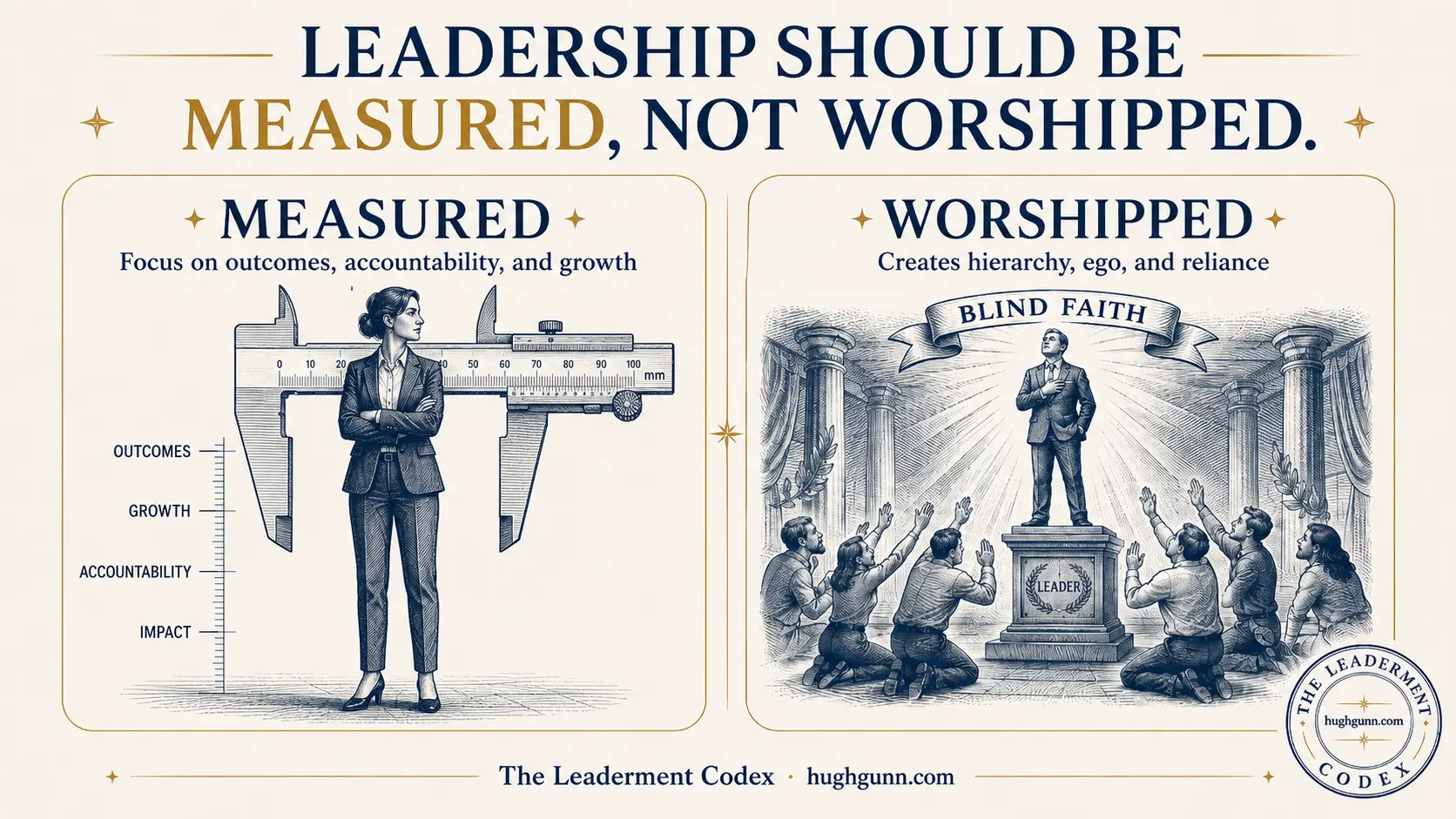
We do not appoint leaders. We anoint them — for the one who fills the room, holds the gaze, and speaks last and loudest. We call the feeling they produce “leadership”. It is the oldest mistake in the discipline, and it persists because the feeling has a name and a formula of its own.
The feeling is Charisma, and Charisma is not a mystery. It is a ratio.
Look at what sits on the bottom. Humility. To raise Charisma you need no more competence and no more results — you need less correction. The leader who never concedes, never revises and never visibly doubts is more magnetic than the one who thinks aloud and changes their mind. The trait we reward with worship is, by construction, the trait that erodes a leader’s willingness to be wrong — and low Humility lets Ego inflate, one half of Chaos (Chaos = Pride × Ego, Equation 1). Worship is not a harmless taste for the exciting candidate. It is a selection mechanism, and it selects for the person most likely to detonate the thing they were given to run.
You might object that experienced people can see through this — and you would be half right. Gut feel is real: it is pattern recognition running faster than conscious thought. When a seasoned leader walks into a room and senses something is off before a word is said, they are not guessing; their unconscious has already scanned for the Say-Do gaps, the Confidence not grounded in Ability, the stated position that contradicts the conduct. The equations have already run. They have simply not yet surfaced.
But Charisma is the great deceiver of gut feel. A high Charisma score mimics every signal experience has learned to trust: it presents as Conviction when it is merely certainty, as Authority when it is merely performance, as Virtue when it is merely the absence of contradiction — so far. The gut reads the output and returns a false positive, because the inputs look identical to the real thing. This is how whole organisations march behind a leader while every underlying variable is already failing. The people around Lance Armstrong felt it. The people around Elizabeth Holmes felt it. They were right that something exceptional was present. They were wrong about what it was. The only gut that reads Charisma correctly is the one that has been burned by it before; everyone else is fooled until the bill — the Chaos Tax — falls due.
Which is the whole case for measuring rather than worshipping. The feeling can be forged; the variables beneath it cannot. So stop reading the feeling and read the variables — and the first thing you notice is that leadership is not a feeling at all. It is a quantity, built from parts, every one of which can be measured. Start with Power.
Each of those three terms unpacks into measurable parts of its own:
That is eight distinct variables — what you believe and whether others credit it, what you can actually do, what you are worth and how widely it is seen against the Competition, whether your actions match your words, and whether you will be corrected. Run your eye down them and notice what is absent: Charisma is nowhere in the equation for Power.
Worse for the worshippers, look where Humility goes. It sits in the denominator of Charisma and the numerator of Virtue. The same trait that costs a leader their magnetism is the one that builds their Power. Worship and measurement do not merely diverge — they pull in opposite directions. The crowd is drawn to precisely the quality the equation docks you for lacking.
Power, though, is only potential — the capacity to act. The final measure is Effective Power: the Power that actually does work once the world pushes back.
It takes the Power a leader holds, multiplies it by the Resources they can command and the Autonomy they can hold under pressure, and divides the result by the two forces that drain it — the Chaos they generate and the Administrative Impotence they tolerate. A leader can score high on Power and deliver nothing, because the denominator ate it. Effective Power is the only honest answer to the question was this person any good — not how they made the room feel, but what their Power actually moved and what it left standing.
Charisma is what you feel in the room.
Effective Power is what is left when the leader leaves it.
This is why the dull operator so often beats the dazzling one. Amundsen reached the Pole and brought every man home; Scott reached it second and died in the snow — and it was Scott the nation mythologised. One built a system to be measured against reality; the other built a legend to be admired. Reality does not read press cuttings, and it does not score Charisma.
So measure. Run the stack — Authority, Influence and Virtue, up into Power, and Power into the work it actually did. The equations do not replace gut feel; they calibrate it — a conscious route to the same answer for those without forty years of scars, and a language for it for those who have them. Worship asks whether you believe in them. Measurement asks what they moved. Only one of those questions has ever kept a system alive.