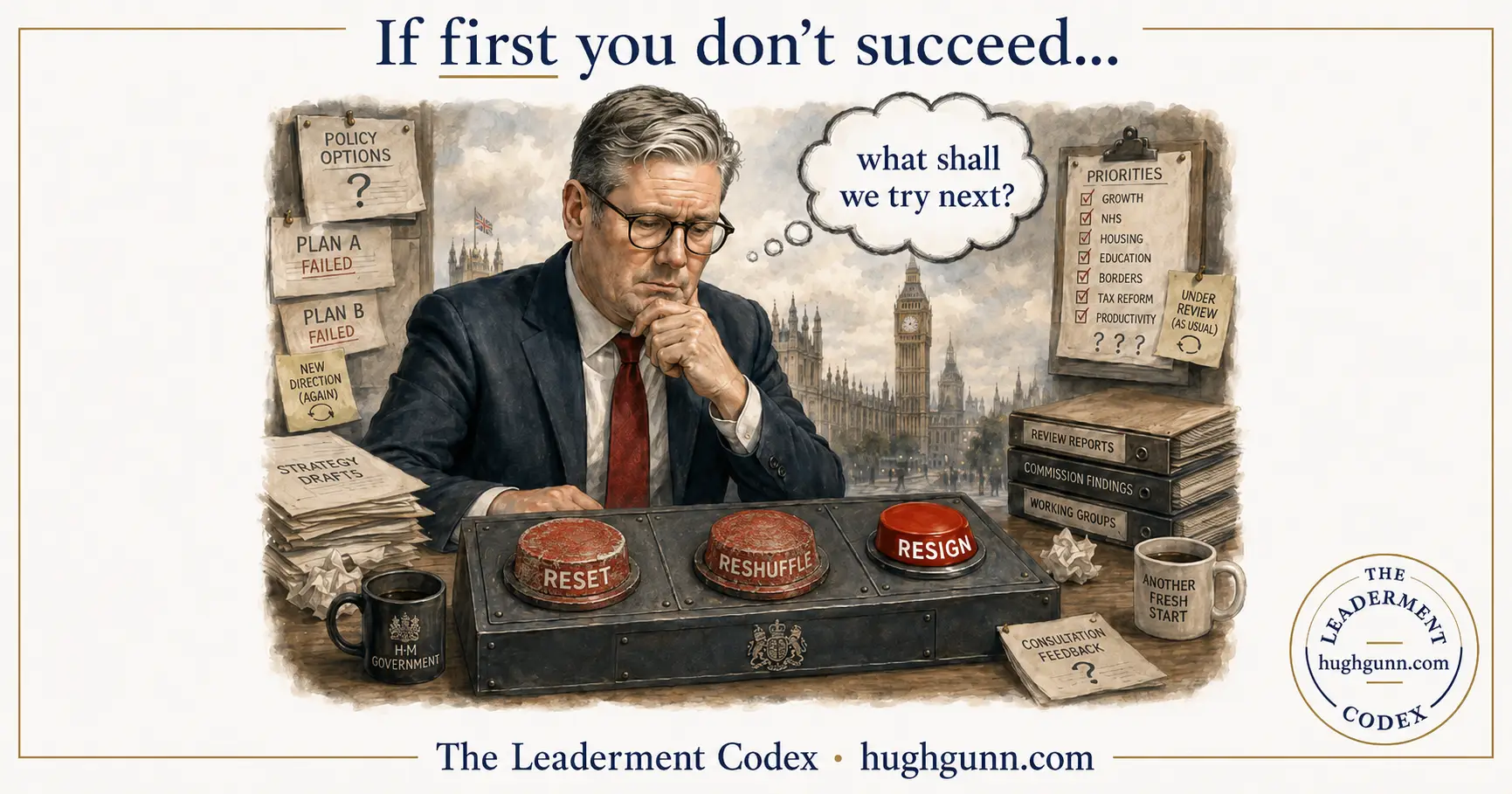
Is it possible to be a ‘Winner’ and a ‘Failure’ at the same time?
Keir Starmer, a serial winner, just walked out of Downing Street beaten by his own side. After a series of wins he resigned this morning (22/6/26).
Let me concede the obvious before anyone reaches for the comments: a landslide is not nothing. Win a three-figure majority and you have done something most leaders never manage in a career. So the argument here is not that Keir Starmer cannot win. It is the opposite. He is one of the most dependable winners in modern British politics — which is exactly why he is the right place to begin, because winning and succeeding turn out to be different things, and his career is the cleanest demonstration of the gap I know.
Give the man his due. He took his seat in 2015. He took the Labour leadership in 2020. He took a general election in 2024. And between the second and the third he was, whatever you made of his politics, a genuinely effective Leader of the Opposition — disciplined, forensic, and ruthless enough to march his party from its worst defeat since 1935 to the threshold of government in a single term. On paper, a serial winner.
2020 — Won the Labour leadership
2024 — Won a general election, majority of 174
What each win actually was
Now examine them one at a time, because the tally flatters him.
Start with the leadership. He won it in 2020 — but ask how. Not on a creed anyone could recite back to you, but on position. He arranged himself as broadly what the Parliamentary Labour Party wanted, and, far more carefully, as not the things it had learned to fear: ten pledges that nodded left, a manner that settled the centre, and a studied refusal to be nailed to any of it. That is a win. But it is a win of the power game — being the most acceptable option in the room rather than the most convincing one. Hold that thought, because he never put the tactic down.
Now the election, and let us be precise about it: it was not a win so much as the absence of a loss. The country did not pick Starmer in 2024. It finally declined to re-pick the Conservatives — and under first past the post that refusal dropped into Labour’s lap as a mountain of seats it had done very little, in votes, to earn.
The figures say so without flinching. The 174-seat majority rested on 33.7% of the vote — 1.6 points above the share Labour was buried with in 2019. On a lower turnout it came to fewer raw votes than the party managed in that defeat. The same electorate that had crushed Labour handed it the country back, having barely shifted its mind at all. The seats were an avalanche; the vote was a flicker. That is not a nation won over. It is a nation walking away from the other side — a very different thing to have beneath you when the wind comes round.
And it is the equation that explains why the difference is fatal rather than cosmetic.
| Effective Power = |
The numerator looked enormous, but its size was on loan — borrowed from the opponent’s collapse, not built under Starmer’s own feet. The blank screen that won him the leadership and the not-the-Tories mood that won him the country are the same manoeuvre run twice: win by being the acceptable absence of an alternative. It is a real way to win. It is also a way that works precisely once. The day you take office you acquire a record, you become the thing the next protest measures itself against, and “not the other lot” is a sentence you may no longer finish — because now you are the lot.
There is a companion equation that catches the same flaw from the side of public standing rather than office.
| Influence = |
Influence does not require you to be good. It requires Value, Visibility, and — quietly the most decisive of the three — a weak field to stand against. Starmer’s Influence spiked in 2024, but not because Value or Visibility had climbed. It spiked because Competition collapsed: the Conservatives imploded and the denominator simply fell out from under the fraction. A reading that rises because the bottom drops away is the most treacherous number in leadership, because nothing you did is holding it up. The moment Competition reconsolidated — Reform gathering the right back into a single fist — the denominator returned, found no Value beneath it, and the figure came down as fast as it had gone up.
On 22 June 2026, less than two years after the landslide, he resigned — beaten not by the country but by his own party. The serial winner had run out of the only thing he ever really won with: somebody else to not be.
The same shape, a different rosette
Boris Johnson ran the move from the opposite bench and got the same ending. An 80-seat landslide in 2019, “Get Brexit Done,” the most commanding Conservative mandate in a generation — and gone by 2022. His numerator was real where Starmer’s was borrowed, but the denominator did the work all the same: removed not by the country but by his own party, the moment the Chaos beneath the win caught up with it. Two men, two crushing single events, and not a second win between them.
The win that does repeat
Now set both of them beside Tony Blair and Margaret Thatcher. Three election wins each. That is success — the result reproduced, not merely achieved. Blair is the cleanest case the modern era offers: 1997, 2001, 2005, the only one of the four who proved the win was a method rather than a moment, and who did it on votes won rather than votes withheld from the other side.
Thatcher is the instructive one. She won three times and still ended as Johnson and Starmer did — removed by her own side, not the electorate. Which tells you something the poster does not: consistency buys time, but it does not buy immunity. Even a leader who has cracked the repeat is not safe from the term that ends most of them.
Isn’t a bigger win the answer?
The objection writes itself. If one win is fragile, surely the fix is to win harder — a larger majority, a deeper mandate, more in the numerator. Quite the reverse, and this is where the Codex earns its keep. The danger does not sit in the numerator at all. It sits underneath.
The win itself inflates the denominator. Victory feeds Pride and feeds Ego, Chaos climbs, and the next reading of Effective Power comes back lower than the one that earned the trophy. The bigger the win, the harder the feeding — which is why the most commanding mandates so often curdle the fastest. The event that looks like the summit is, mechanically, the thing that begins the descent.
So a bigger win is not success. Success is holding the denominator down long enough to win again — and again — while everyone around you is still celebrating the first one. That is a discipline, not a moment, and it is rarer than talent because it requires a leader to distrust the applause that talent attracts.
You can win without succeeding. Most leaders do — and the win is often the reason.
Effective Power is the keystone equation of The Leaderment Codex — the one the book is named for. The other twelve explain, in their various ways, why the celebration is so often the start of the decline.