“Power does not change a person; it merely unmasks them.”
Britain may be about to acquire a Prime Minister it was never asked to choose. Every step that put him there stayed inside the rules. That is exactly what should worry you.
Is this democracy?
Technically, yes.
A sitting mayor decides the top job is within reach. A safe Labour seat is vacated to make room. A by-election is held, and won — convincingly. The parliamentary party turns that foothold into a leadership route. And a man no national electorate has ever chosen stands days from Downing Street.
Every step can be defended on its own. That is the problem.
Power does not always fail by breaking the rules. Sometimes it fails by using them so neatly that the public only notices once the outcome has already been arranged. The last time a Commons seat was emptied to order for someone who was not even an MP, Harold Wilson was Prime Minister and England were the reigning world champions. Sixty years. That is how rare the manoeuvre now unfolding around Andy Burnham actually is — and it has been executed in plain sight, with total procedural correctness, by people who never once had to break a rule to get what they wanted.
This is not leadership. It is power cosplay — and it wears the costume well.
What the costume is made of
Power, in the Codex, is not a single thing you seize. It is a product of three factors — and because they multiply rather than add, a shortfall in any one drags the whole product down, however impressive the other two. Walk them across what just happened.
Authority (Conviction × Recognition × Ability) — he has it, genuinely. A decade as a metro-mayor, name recognition most politicians would trade a limb for, and a conviction politics — the “King of the North” — that is the opposite of a blank screen. Authority: real, and high.
Influence (Value × Visibility ÷ Competition) — he has this too, and note why it surged: the denominator. Competition collapsed. The incumbent fell, rivals stood aside, the field cleared — and Influence rises automatically when the bottom of the fraction drops away. The same vacuum that flattered his predecessor’s numbers now flatters his.
Virtue (Congruence × Humility) — here is the hole. And the Codex is blunt about what Virtue is: the invisible throne others build for you. It is not a thing you take; it is a thing you are granted, by people who have watched whether your word and your deed agree. That is precisely what the manoeuvre routed around. No national electorate built him this throne — a single constituency and a show of hands among colleagues did the work a country is meant to do. And the Congruence inside Virtue took its own knock: a man elected to serve Greater Manchester until 2028 left the post the moment a larger prize appeared.
So: high, times high, times a factor scraping its floor. Two terms gleaming, one all but absent. And the missing one is the term you cannot see from the outside — which is the entire trick.
The Charisma Mask
If the Virtue is missing, why does almost nobody seem to mind? Because of the equation sitting next door.
| Charisma = |
The Codex warns what this equation is: charisma is the smiling face of confidence and ego — mistaken for leadership until humility runs out. Burnham has it in abundance — the warmth, the certainty, the everyman ease that wins a by-election by more votes than every rival combined. And there is a cruel symmetry in the algebra worth pausing on: Humility sits in the denominator of Charisma and the numerator of Virtue. The same scarcity that pumps the mask up hollows out the throne behind it. The more the projection dazzles, the less the mandate gets audited.
That is the Charisma Mask. An unthroned leader with no charisma looks like a backroom stitch-up. The same leader with charisma to spare looks like destiny walking up Downing Street. The costume is not merely worn — it is magnetic, which is exactly why no one asks to see what is underneath.
The bill for the fancy dress
A costume this elaborate is not free.
Because a metro-mayor holding police and crime powers cannot also sit as an MP, the by-election that put him into Parliament automatically emptied his old chair — forcing a second, regional contest to replace him. Two elections: one to install him in Westminster, one to fill the hole he left behind.
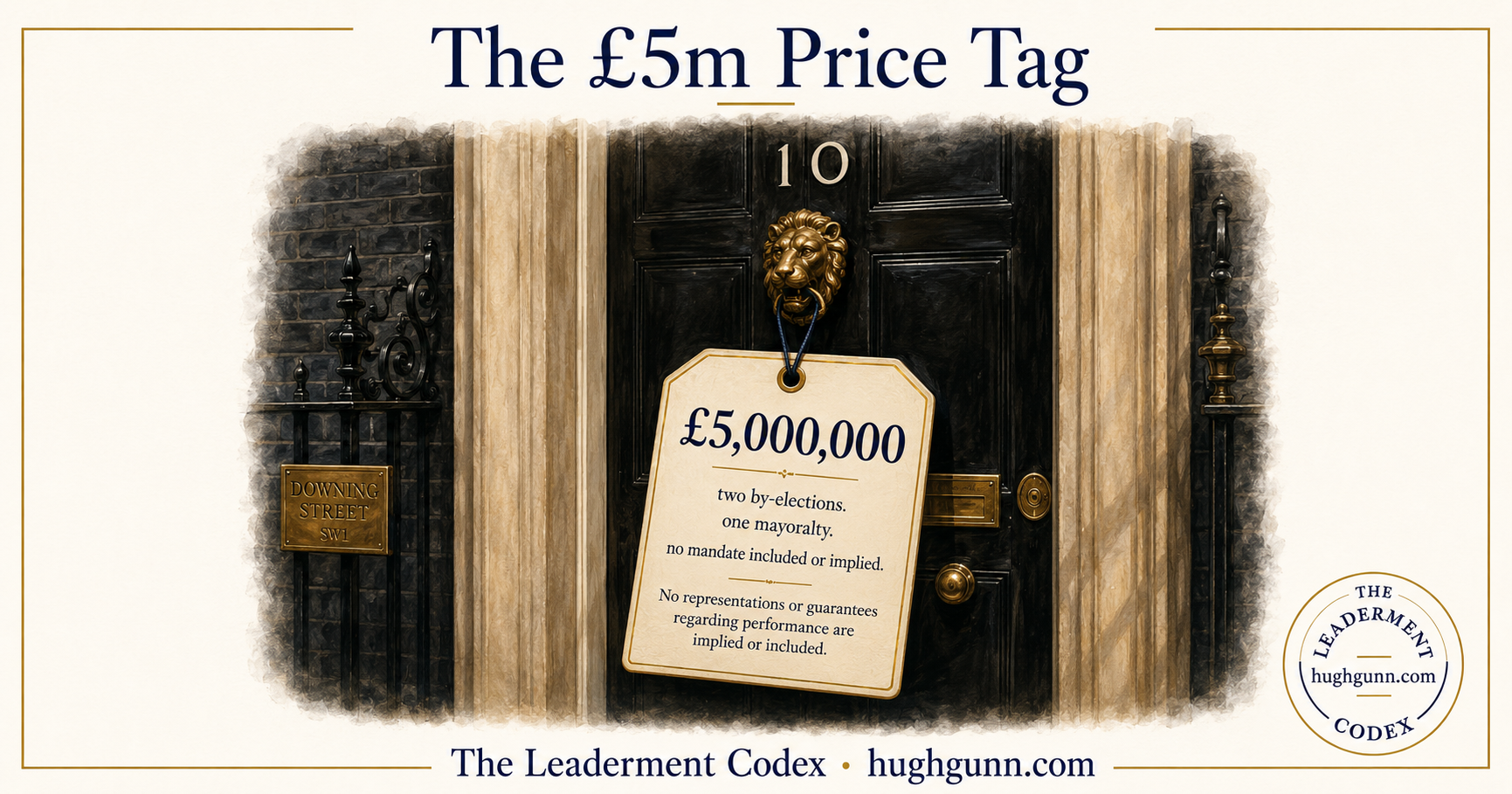
The Makerfield by-election, plus the Greater Manchester mayoral contest his victory triggers, runs to something close to £5m of public money — the bulk of it, around £4.5m, the cost of the mayoral re-run alone. Not spent on hospitals, housing, or anything a citizen could point to and touch. Spent on the logistics of a single career move.
That is Administrative Impotence with the receipt still attached: the machine consuming public resource to service its own succession. And the Effective Power equation adds the sting — it divides Power by, among other things, Administrative Impotence. The very manoeuvre that installs him inflates the denominator of the office he is inheriting. He has fought through the machinery to win a chair the machinery has just made less effective to sit in.
All that motion, no progress
| Progress = |
The Codex calls Progress a mirage born from the heat of Chaos — we celebrate the act of fire-fighting while the building continues to burn. Look at the top of the fraction: Ambition, overflowing. The whole episode is ambition made visible. But Progress divides ambition by Chaos × Administrative Impotence — and the manoeuvre has just maxed both. The country spends £5m, vacates a mayoralty, fights two by-elections and changes Prime Minister, and ends roughly where it began: one tactical manager swapped for another, no mandate gained, no problem solved. Enormous motion above the line, matched term for term below it. Net Progress: the mirage.
And here is the part the fire-fighting metaphor makes plain — the fire was lit in-house. The Chaos in that denominator is not weather that blew in from outside. It is the leadership crisis the party generated itself. You cannot claim the credit for fighting a fire you started.
Power can be assembled. Virtue has to be granted. Until it is, what you are watching is not a leader taking office — it is a very able man, in a very good costume, walking into a building he was never quite invited to run.
And when the costume comes off — as the Codex promises it will, because power does not change a person, it only unmasks them — we will find out whether there was a throne underneath all along, or only ever the mask.
Power is the twelfth of the thirteen equations in The Leaderment Codex. Virtue is the eleventh — the cheapest factor to skip, right up until the moment it is the only one that matters.