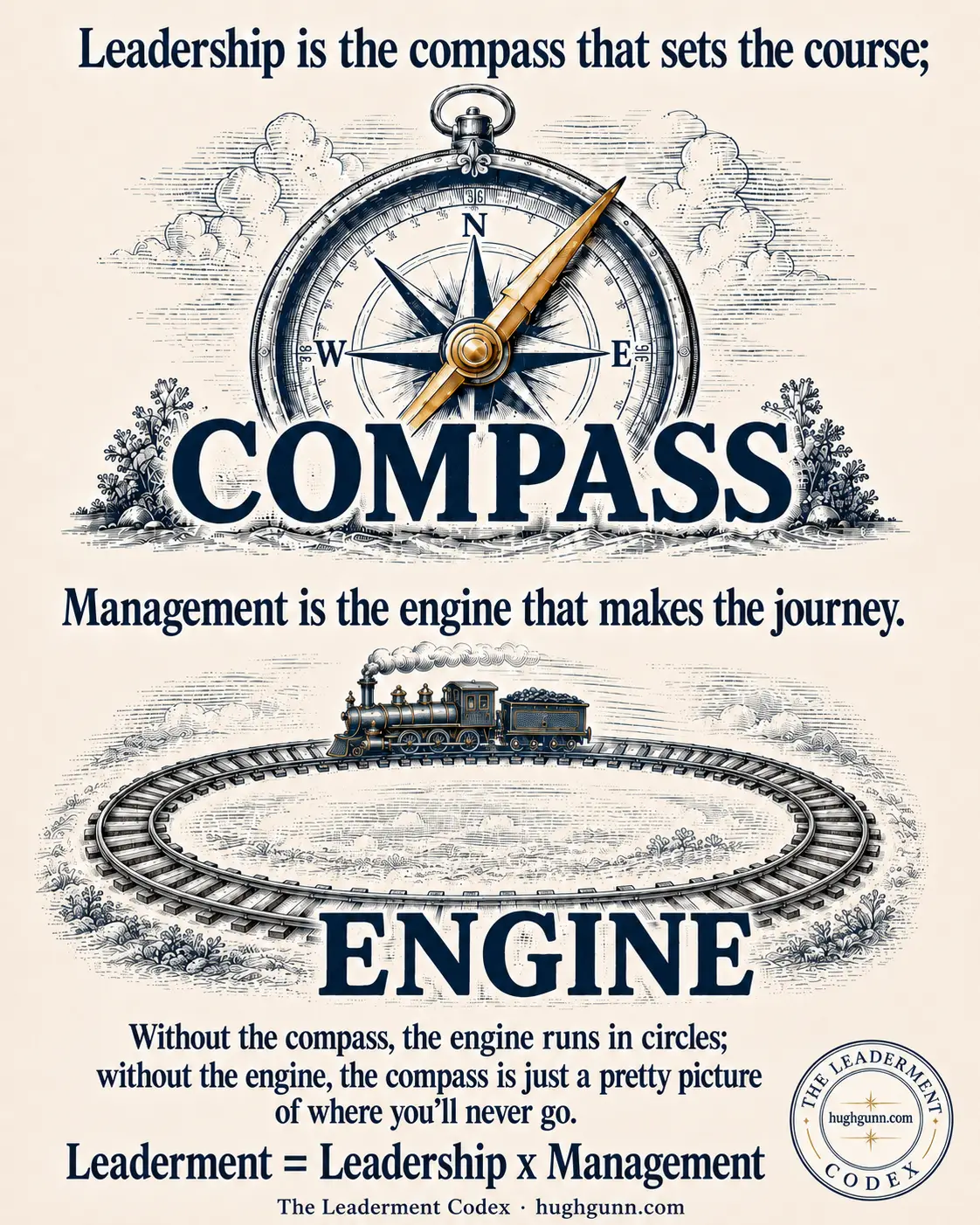
Leadership and Management are not two ends of a spectrum you pick a comfortable spot on. They multiply — and multiplication is far less forgiving than a spectrum lets you believe.
Leadership is the compass. It answers the only two questions that set a direction: where are we going, and why. Management is the engine. It answers the other two: how, and what. One chooses the heading; the other covers the ground. Neither is the senior partner — the model gives them equal billing in a single word.
Leaderment = Leadership × ManagementThe operator in that equation is the whole argument. Not a plus — a times. A sum forgives you: a weakness in one column can be offset by strength in the other, and you average out respectable. A product does no such thing. A leader who scores nine for vision and one for execution does not score five. They score nine times one. The towering half is wasted against the missing one, and the result sits on the floor, next to the weaker number.
Leadership is the compass that sets the course; Management is the engine that makes the journey. Without the compass, the engine runs in circles; without the engine, the compass is just a pretty picture of where you’ll never go.
There are two ways to land on that floor, and each feels like competence from the inside. The engine without the compass is all motion and no heading — prodigious effort, immaculate process, the team exhausted, the quarterly numbers met, and the whole apparatus running in a perfect circle. Activity gets mistaken for progress because there is so much of it. The compass without the engine is the opposite, and just as common: a beautiful strategy, a confident heading, a deck that wins the room — and nothing that actually moves. A pretty picture of where you’ll never go.
The trap is that people answer a low score by reinforcing the half they are already good at. The visionary, stalled, hires more visionaries. The operator, becalmed, adds more process. Both are pouring effort into the factor that is already high — and in a product, adding to the larger number barely moves the result. The leverage is always in the weaker factor. A nine-and-one leader who doubles their vision to eighteen still scores eighteen; nudging their execution from one to two doubles the whole thing. The maths points squarely at the thing you are worst at, which is precisely the thing you least want to look at.
This is why the model refuses the usual phrase “leadership and management” and insists on one word: Leaderment. The “and” invites you to treat them as separable — two departments, two people, two halves of an org chart that someone else is presumably handling. The multiplication says they are one capability wearing two coats, and your score is set, quietly and without appeal, by whichever of them you have been neglecting.
Leadership sets the heading; Management makes the miles. Multiply them — and mind the smaller number, because that is the one writing your score.
Because leadership should be measured, not worshipped.