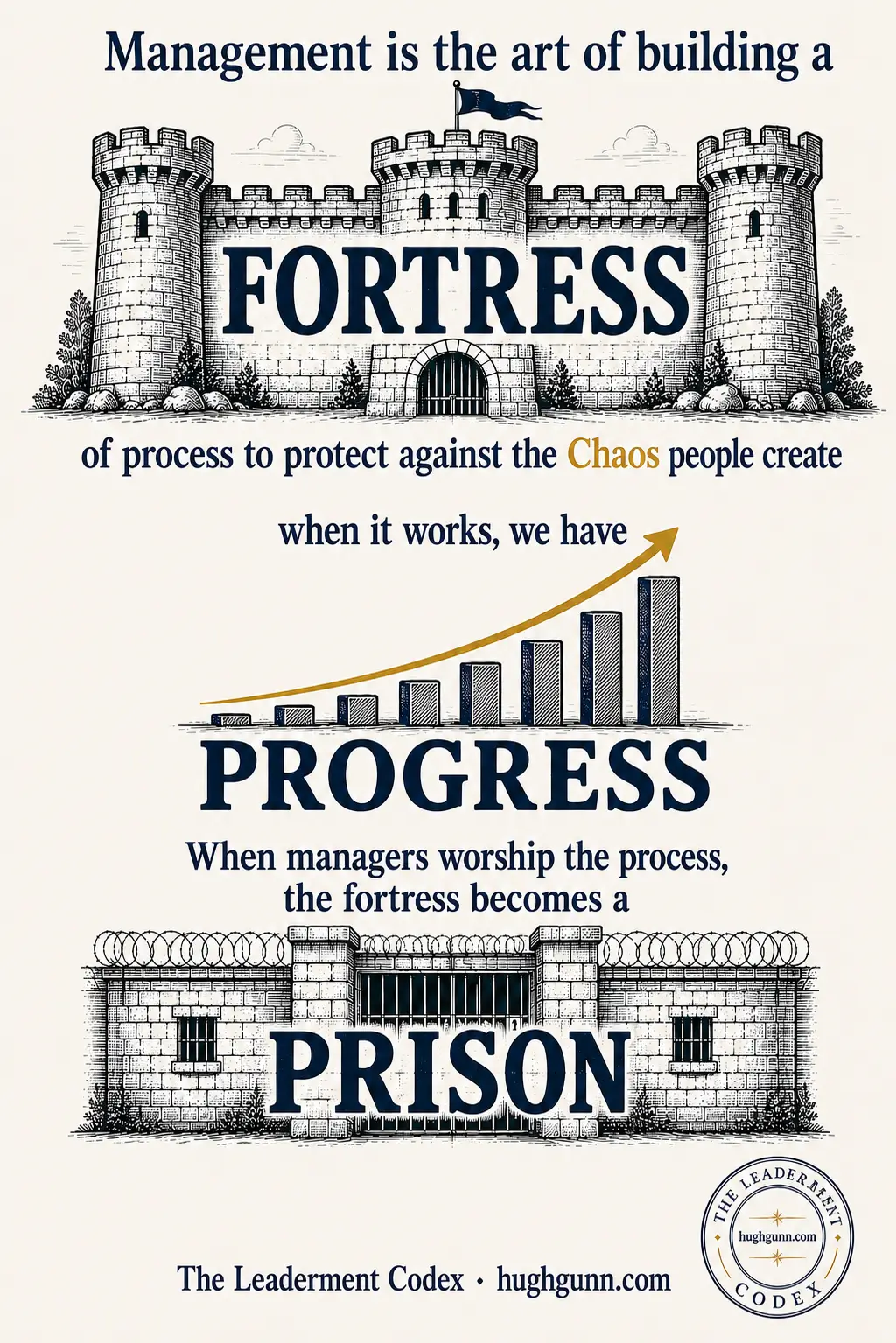
Process exists to protect progress. Its most reliable failure is to strangle the very thing it was built to serve.
Management exists because people, left to their own devices, generate Chaos. Not through malice — just the ordinary entropy of competing intentions, forgotten promises, and the thing that was obvious to one person and invisible to everyone else. Process is the wall you raise against it: a fortress that keeps the disorder out so the work can move. Built well, it is how progress happens at all. The model treats this as honourable work.
Management = (Process × Defined Output) ÷ Administrative ImpotenceThe structure carries the warning. Process sits in the numerator — but only as a multiplier of Defined Output, the specific, measurable thing it exists to produce. A process with no output it serves is not in the numerator at all. It has migrated to the denominator, where it joins Administrative Impotence (Bureaucracy × Corporate Drag): the dead weight that turns good intentions into slow, diluted nothing.
Management is the art of building a fortress of process to protect against the Chaos people create. When it works, we have progress. It is when managers forget the reason for the process and worship the process itself that the fortress becomes a prison.
And here is where it starts to choke — because that denominator is not Management’s alone. The same Administrative Impotence sits beneath the Progress equation:
Progress = k × (Ambition × People × Environment × Intent) ÷ (Chaos × Administrative Impotence)So when process detaches from its outcome and swells that denominator, it does not merely slow Management down. It throttles Progress at the source — chokes the forward motion the fortress was built to protect. The fortress, untended, becomes a prison, and the prisoner is progress itself.
It happens at a precise moment: when the people inside stop asking what the process is for and start treating the process as the point. The approval chain that once caught real errors now exists to be an approval chain. The form survives because of one incident in 2014 that nobody can quite remember. “Follow the process” quietly replaces “hit the outcome” — and the day those two part company is the day the denominator climbs and progress begins to die.
The test is unkind but simple. Point at any process and ask what Chaos it protects against. If someone can name it — the specific disorder, the real risk, the actual harm — then it is a wall, and it earns its place in the numerator. If the honest answer is “it’s just how we do things here,” you are looking at a bar, not a wall. It belongs in the denominator, and it is choking your output whether you can see it or not.
So the rule is unsentimental: every process is a tenant, not an owner. It rents its place in the numerator by naming the outcome it protects, and the moment it cannot make rent — cannot tell you what it is for — you evict it. Most organisations do the reverse. They grant process tenure. That is how a fortress quietly fills with rooms nobody is allowed to leave.
It is also why Management cannot run alone. Management answers how and what; it is Leadership that answers where and why — and “why” is exactly the question a worshipped process has stopped being asked. Strip the why away and you are left with flawless execution of a purpose nobody remembers choosing: the engine running beautifully, at full power, behind a very high wall, going nowhere.
Build the fortress. Just keep the key.
Because leadership should be measured, not worshipped.