A government whose own policy pushed inflation to nine per cent reverses course, the figure eases to 8.9, and the dip is announced as a triumph. That is not progress. It is scoring an own goal and then celebrating the equaliser.
Progress is a plain thing, and worth keeping plain: movement towards a goal you set in advance. You are nearer the thing you meant to reach than you were. That is all it is — and it is usually visible, because a goal you can name is a goal you can measure your distance from. Real progress does not need a press release to be detected.
Activity often gets mistaken for progress — but being busy and getting stuff done are not mutually exclusive. The most convincing counterfeit of all is the heroic recovery from a self-inflicted mess. You generate the chaos. You fight the chaos. You claw your way back to roughly where you started, exhausted and triumphant, and you call it “progress.” But the goal has not moved. You have run very hard and arrived at the starting line. Bravo.
The equation is unsentimental about why.
Whatever your numerator produces — the real movement bought by Ambition, People, Environment and Intent — is divided by Chaos and Administrative Impotence. Both are self-made: Chaos is Pride × Ego, Administrative Impotence is Bureaucracy × Corporate Drag. So self-imposed chaos does not merely fail to be progress; it actively consumes the progress you would otherwise have made. Generate enough of it and the division drags you back to where you began. The energy spent fighting it is the most expensive way ever devised to stand still.
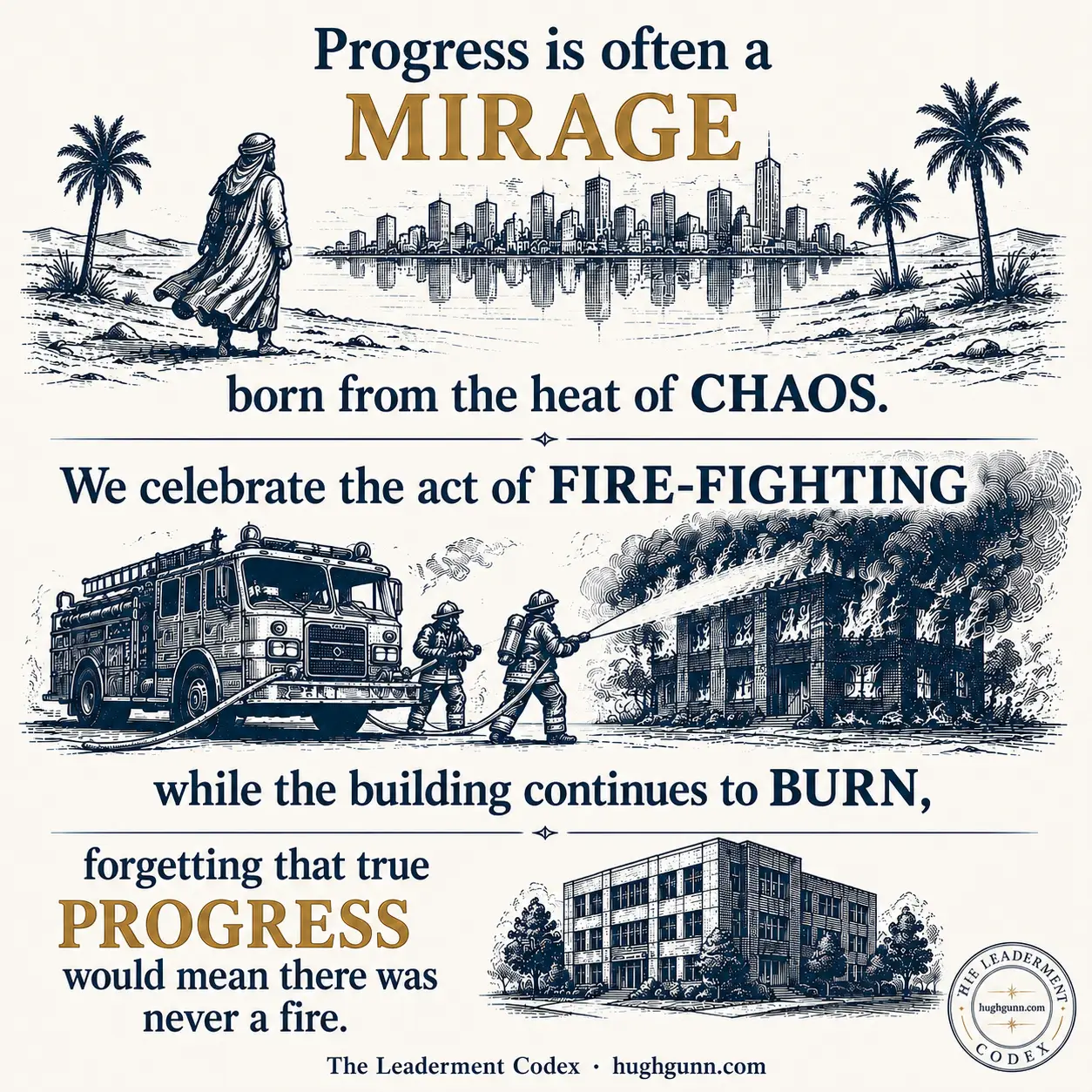
Progress is often a mirage, born from the heat of Chaos. We celebrate the act of fire-fighting while the building continues to burn, forgetting that true progress would mean there was never a fire.
This is why the inflation figure is such a tell. A drop of nought-point-one, hailed from the despatch box, is a recovery from a self-inflicted wound dressed as forward motion — the own goal scored, the equaliser celebrated, the match still very much not won. The same theatre runs in every organisation that promotes the manager who heroically rescues a project from a crisis their own decisions created. We are rewarding Nero for extinguishing his own pyrotechnics.
Not every fire is self-made. A genuine external shock — a true black swan, the k in the equation, which you neither caused nor could foresee — is a real fire, and fighting it is real work, legitimately done. But fighting even that is protecting the run towards the goal, not the run itself. Progress is the ground you take towards what you set out to reach. Recovery, however heroic, only ever returns you to a start line you should never have left.
So the work that actually produces progress is the unglamorous kind: scoring fewer own goals. Reduce the chaos and the drag, and the numerator’s output stops being divided away — it reaches the goal instead of being spent on the rescue. There is no equaliser to celebrate, because you were never behind. Which is, of course, precisely why nobody claps.
Progress moves you towards the goal. Cleaning up your own mess moves you back to the start — and calling that a win is the costliest own goal of all.