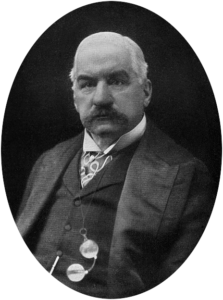
JP Morgan
J.P. Morgan (1837–1913)
- Reorganised America's broken railroad system through a process that became known as Morganization — acquiring failing lines, replacing management, imposing cost discipline, and consolidating competing routes to eliminate destructive rate wars — gaining financial control over roughly one-sixth of the country's rail lines by 19001Britannica — J.P. Morgan and forming the world's first billion-dollar corporation in US Steel in 1901.2Wikipedia — J.P. Morgan
- In 1895, with the US Treasury's gold reserve on the brink of depletion, headed a banking syndicate that loaned the federal government more than $60 million in gold to relieve the crisis3History.com — J.P. Morgan — then in 1907, at seventy years old, assembled the nation's leading financiers at his Manhattan library, locked the door, and did not let them leave until they had agreed a coordinated rescue plan that ended the panic.1Britannica — J.P. Morgan
- Testified before the Pujo Committee in December 1912, which found that Morgan and his partners controlled aggregate resources of $22 billion — compared by Louis Brandeis to the total value of all property in the twenty-two states west of the Mississippi River2Wikipedia — J.P. Morgan — and died four months later in March 1913, the same year Congress created the Federal Reserve System that his 1907 intervention had made necessary.
John Pierpont Morgan operated at a scale no private individual has matched before or since. In the absence of a central bank, a federal reserve, or any meaningful government mechanism for financial stabilisation, Morgan became the mechanism. He did not inherit this position. He constructed it, over four decades, through a combination of technical ability that most bankers of his era could not approach, a Congruence between stated intention and delivered outcome genuinely unusual for a man of his power, and a Pride so thoroughgoing that the possibility of failure appears not to have registered as a serious analytical category.
The Railroad Reorganisation era established the template. What Morgan perceived in America's broken railroad system was not a collection of failing businesses but a systemic coordination failure — competing lines destroying each other's value through rate wars and duplication, when consolidation and rationalisation would benefit all parties including the bondholders whose capital he represented.2Wikipedia — J.P. Morgan Morganization was not financial engineering in the pejorative sense. It was the application of genuine operational intelligence to systems that had been built without it. The process required him to take effective control of the railroads he reorganised, install professional management, impose cost discipline, and hold the line against the short-term pressures that had produced the dysfunction in the first place. That required Conviction and Autonomy at levels most bankers — then or now — could not sustain.
The industrial peak period is the era that produces the most extraordinary equation outputs. The formation of the world's first billion-dollar corporation, the rescue of the US Treasury, and the reorganisation of industries that had previously operated without coherent capital structure were not separate achievements.1Britannica — J.P. Morgan They were expressions of a single coherent capability: the ability to see the structural logic of a system that was larger than any of its individual components, and to act on that logic with sufficient Resources, Recognition, and Autonomy to make it real. The Environment variable at this period reflects the genuine exceptionalism of the Gilded Age capital formation context. Morgan did not create those conditions. But he was better positioned to exploit them than any contemporary, and the equations correctly record the amplification.
The Panic of 1907 is the profile's defining data point and the most important single leadership act in the Business domain dataset. No government mechanism existed to prevent the collapse of the American banking system. Morgan, at seventy years old, assembled the nation's leading financiers in his Manhattan library, locked the door, and did not let them leave until they had agreed a coordinated rescue plan.1Britannica — J.P. Morgan The panic was an external shock of genuine severity — and the equations show what happens when exceptional numerators operate against a severely adverse denominator. The Effective Power score remains high because Conviction, Ability, Autonomy, and Resources at their peak are not suppressed by even a significantly negative external environment. They are merely constrained by it. Morgan constrained it back. The panic's resolution, and the recognition that no single private individual should again be required to perform this function, directly prompted Congress to establish the Federal Reserve System in 1913 — the year Morgan died.2Wikipedia — J.P. Morgan
Two variables run consistently low across all three snapshots and require acknowledgement. Humility sits at its floor throughout — there is no documented evidence of epistemic openness, public acknowledgement of error, or genuine receptiveness to challenge. Morgan's intellectual process appears to have been one of rapid private assessment followed by irrevocable commitment. He was almost always right. The absence of Humility in his profile is therefore analytically interesting rather than obviously damaging — he did not need the correction mechanism because his first-principles judgement was sufficiently accurate that the correction mechanism would rarely have improved the outcome. Whether that represents a genuine exception to the framework's general logic, or whether it reflects the survivorship bias of a historical record that necessarily omits the decisions that were never made, is a question the equations cannot answer.
The second consistent observation is the relationship between his Chaos score and his Effective Power. Most leaders at equivalent internal friction levels see their output severely constrained. Morgan's did not, because his numerators were operating at a scale that no contemporary could match. The 1907 snapshot illustrates this most clearly — negative external conditions, elevated Chaos, and Effective Power still exceptional. The equations are recording what the historical record confirms: that Morgan's internal friction was high and largely irrelevant, because the force he was applying was larger than the friction could consume.
What the Pujo Committee identified as a dangerous concentration of financial power,2Wikipedia — J.P. Morgan the equations record as exceptional Autonomy and Resources in the service of genuine Value. Both descriptions are accurate. They are not in contradiction.
Score Comparison
Add up to 10 leaders. Click a name to visit their profile.
The 13 Equations
Scores for: Banking and Industrial PeakThe 22 Variables
Canonical scoresWhat changed: Railroad Reorganisation Era → Banking and Industrial Peak
Sources & Bibliography
The scores assigned to this leader are derived from publicly available sources. Variable inputs reflect documented behaviour, structural conditions, and historical record at the time of each snapshot.