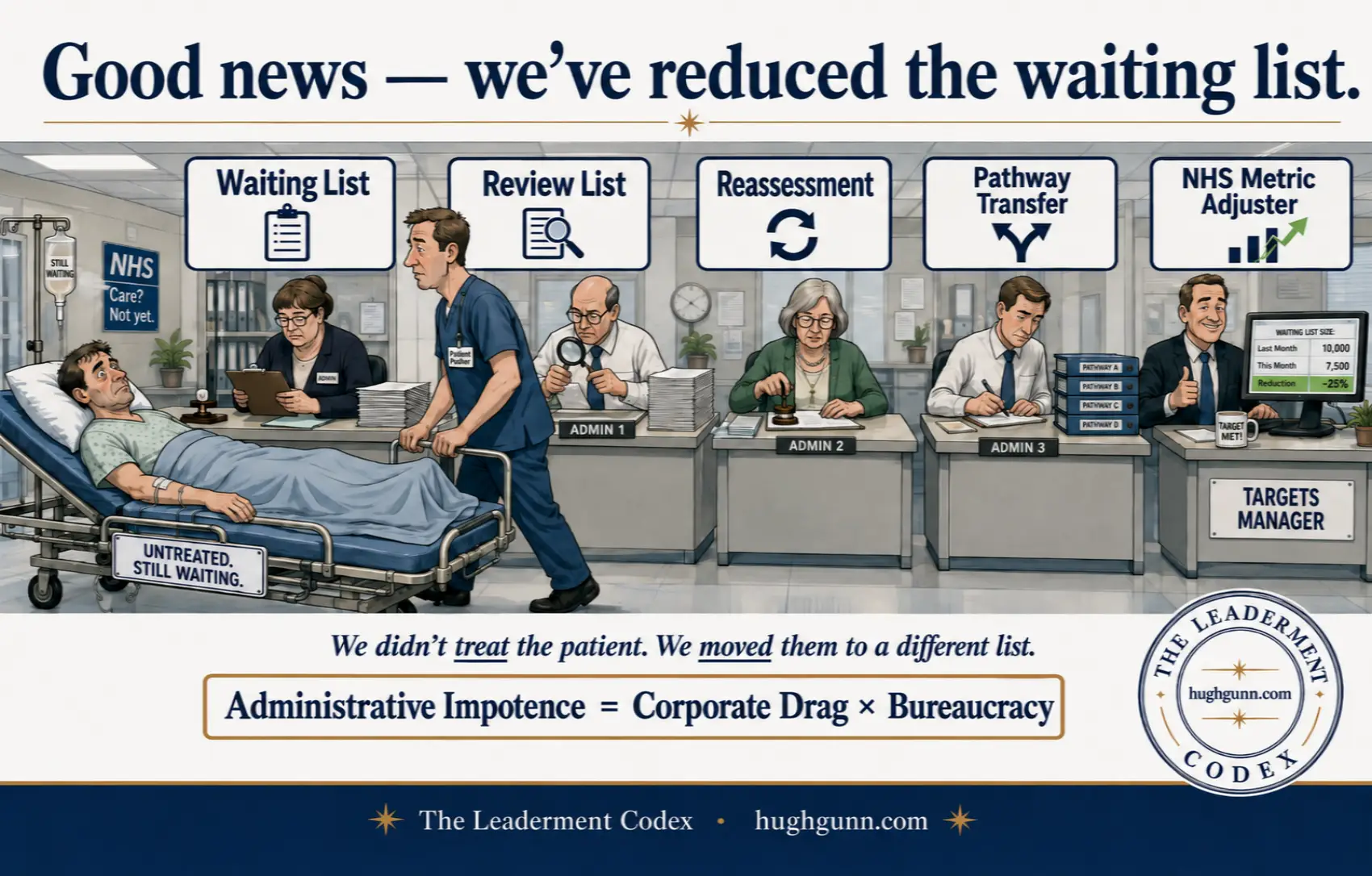
“There’s a process for that.” It is one of the most expensive sentences in the language, and it almost never sounds like it. It sounds like diligence. It gets said at the exact moment the right thing is obvious — obvious and urgent, plain to everyone in the room — and someone reaches for a form instead of the door. We have all stood in that room, and we tend to call what follows a breakdown: the system seizing up, letting us down.
It is not a breakdown. That is the thing worth understanding. The form got filled. The process was followed. Everyone did their job, correctly — and the obvious right thing still did not happen, precisely because everyone did their job. A system can fail you while functioning perfectly. It simply succeeds at the wrong goal. Bureaucracy does not break. It works — at something other than the point.
There are two forces in that equation, and only one of them is the one we complain about. Bureaucracy is the half you can see: the approvals, the sign-offs, the layers, the form in triplicate. It is loud, and it is the half every “cut the red tape” drive goes after. Corporate Drag is the half you cannot — the quieter, heavier force beneath it: a system’s instinct to protect its own hierarchy, its own self-image, its own comfortable account of itself. And because the two multiply rather than add, the invisible half is usually the one doing the killing. You can shred every form in the building, and a high-Drag organisation will stay exactly as impotent as it was — because the forms were never the disease. They were the symptom that agreed to be seen.
You feel Administrative Impotence as an annoyance: a delay, a sigh, a queue that does not move. To see it at full power, watch what it does when the stakes are a human life and the target is a number.
In the first month of 2026, the NHS removed more than a quarter of a million people from its waiting lists. The backlog fell by some 44,000 in a single month, and ministers said — reasonably enough — that the plan was working. Then you read who was removed. Some had gone private. Some had died while waiting. Some were struck off for the administrative crime of not answering a text. Over the same period, the proportion of patients treated inside eighteen weeks barely moved.
The list got shorter. The patients got no faster. The number improved because the number was the target — and a system handed a target will hit it by the shortest available route, which is rarely the one that runs through a ward. No treatment was delivered. A patient, somewhere, is still sick. But in a compliance office, on a spreadsheet, a box went green.
This is the part that ought to sting, coming from me, because measurement is the whole of my argument. So let me be exact about where the failure sits. It is not in measuring. It is in measuring the proxy instead of the thing. The waiting list was never the point; treated patients were. The list was only ever a stand-in for the territory — and the moment a stand-in becomes the target, it stops describing reality and starts replacing it. Let that happen and you do not get progress. You get Administrative Impotence wearing a progress chart.
What you are watching, in every version of this, is a system taking the path of least resistance. Real work is dangerous and hard to audit. Compliance is safe and leaves a clean paper trail. So the system does the safe thing, and reports it as the real thing.
We stop hunting the wolf, because the wolf is dangerous and hard to catch. So we stay in the office, fill out a risk assessment about the wolf — and fine the sheep for standing in the wrong place.
It is tempting to call this cowardice, and tempting to call it conspiracy, and it is neither. There is no villain filling in the form. There is only the arithmetic of a broken denominator: when Administrative Impotence climbs high enough, real output becomes not merely hard but mathematically unaffordable, and the system does the one thing left to it — it games the number, because the number is the only thing still within reach. It protects itself, perfectly, entirely blind to the fact that the building is burning down around it.
And no one installed any of this. That is the part that should keep you awake. Every form was reasonable the day it was added; every process solved a real problem once.
Administrative Impotence is not imposed from outside. It is grown from within — one unchallenged process at a time.
Which means it is not something you inherit. It is something you tolerate into being. And you cannot complain about a bureaucracy you are still feeding.
There’s a Process for That…