American military superiority over Iran has never been in doubt. The United States joined Israel’s strikes on it at the end of February 2026, and that superiority has been on open display ever since. Yet Donald Trump’s power is draining by the week. Those two facts only look like a contradiction if you believe power is force.
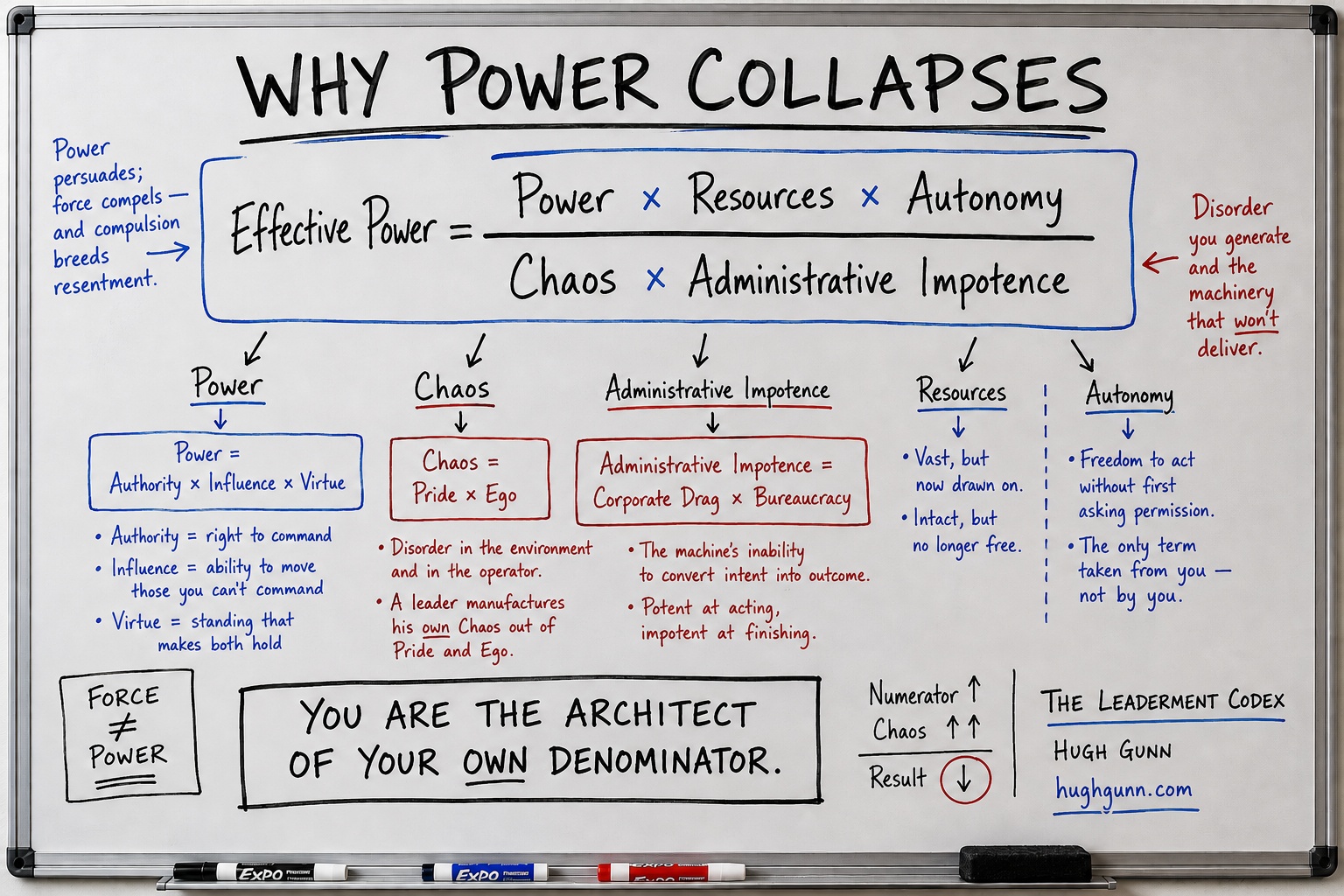
It isn’t. And the difference can be written down:
| Effective Power = |
Power × Resources × Autonomy
Chaos × Administrative Impotence
|
Raw capability lives in the top line, and it is largely intact. Effective power is what survives once you divide it by the disorder you generate and the machinery that won’t deliver. But before we run the case through, a word about the word everyone reaches for first — because it’s the wrong one. In the thirteen equations of the Codex, force isn’t a primary metric.
Force is not power
Force is the folk definition of power, and it is a category error. We call a leader “powerful” when we mean they can compel — yet compulsion is the crudest and most expensive thing power can buy, and the leaders who lean on it are usually the ones who have run short of the real article.
What is the difference between force and power?
The grammar gives the game away. You use force; you exercise authority. “Minimal use of force” is the language of a resource spent by the unit — quantifiable, deployable, costed. You would never say “minimal use of virtue.” The word works as both noun and verb — an armed force, to force a door — but it is instrumental in both, and you cannot “power” a door open. Power is a state you hold; force is a tool you pick up. They are not the same category. In my framework force isn’t even its own term: a weapon is a Resource. It sits in the top line as a tool, not as power.
Power persuades; force compels — and compulsion breeds resentment. That last word is the whole problem, and it compounds. Compel someone and you get the result once; what you are left holding is a person who is harder to move next time. Persuasion appreciates — the persuaded come back willingly. Force depreciates — the forced come back resentful. The same act, opposite time signatures.
How do force and manipulation impact leadership authority?
Two distinctions sharpen it. The first is the bully and the deterrent. A deterrent is force held — kept in reserve, working through the credible possibility of its use. It is force sustained by power: it shapes behaviour precisely because it never has to be spent. A bully is force applied, because the standing to make the threat work wasn’t there, or has decayed. The deterrent that actually has to be used has, in that instant, failed as a deterrent and become mere force. A bully is simply a deterrent that didn’t work — power rotted back down into force.
The second is being sold and making a choice. Force overrides your agency by overpowering your body; manipulation — being sold to — overrides it by hijacking your mind. Both get compliance, both breed resentment the moment they are seen for what they are, and the only thing that doesn’t is the other party keeping ownership of the decision. So the real axis isn’t persuade versus compel; it is whether the other side still feels they chose. Power leaves them owning the outcome. Everything else leaves a residue.
The case, term by term
With that settled, run the present case through the equation.
Power. Power isn’t a primitive; it’s a product:
So the instinct to point at the largest military on earth is the category error again: that’s a Resource. Power is the right to command (Authority), the ability to move those you can’t command (Influence), and the standing that makes both hold (Virtue). These make up the foundation of our core 22 variables. Authority holds — he is Commander-in-Chief and the chain of command obeys. But Influence is shortening: a base in open revolt over the very anti-war platform he ran on, allies cajoled rather than directed. And Virtue is sliding fastest — elected to end foreign wars, now prosecuting one. Two of three multipliers falling means Power falls, and because Power is itself a product, it falls before it even reaches the main equation.
Resources. The vast-but-now-drawn-on term, and where the military superiority actually lives. American reach remains enormous, but it is being spent: interceptors expended in quantity, petrol prices climbing as the Strait of Hormuz is squeezed, political capital burning by the week. Intact, but no longer free.
Autonomy. Freedom to act without first asking permission. This is the one term being taken from him from outside — Congress has moved to fence in his war-making. His Power may be his own; his licence to use it unilaterally is not.
How does a leader self-manufacture operational chaos?
Chaos. Disorder in the environment, and in the operator:
The trait was always high; the war has the state spiking: a ceasefire that won’t hold, contradictory signalling, allies he must warn rather than command. Note what the equation says about the source: a leader manufactures his own Chaos out of Pride and Ego. The denominator is self-built.
What causes administrative impotence in large organisations?
Administrative Impotence. The machine’s inability to convert intent into outcome:
Potent at acting, impotent at finishing. The tell is the gap between declaration and delivery: a deal “two or three days” away for weeks, ceasefires announced and broken. He can order the strike; he cannot, yet, turn it into the settlement he keeps promising. And note — this is not Congress reining him in. That was Autonomy. This is delivery failing on its own.
The Geometric Consequence
Tally it: Authority holds, Resources draw down, Autonomy falls, Chaos rises, Impotence rises — and Power was already sliding before it entered the equation. In an additive model that’s a poor run. In a multiplicative one it’s a collapse, because every term that moves multiplies against every other, and a product inside a product means the geometry bites twice.
Effective power doesn’t leak. It caves in on itself. You are the architect of your own denominator. To calculate how your organisation rates against these structural boundaries, see the complete framework in The Leaderment Codex.