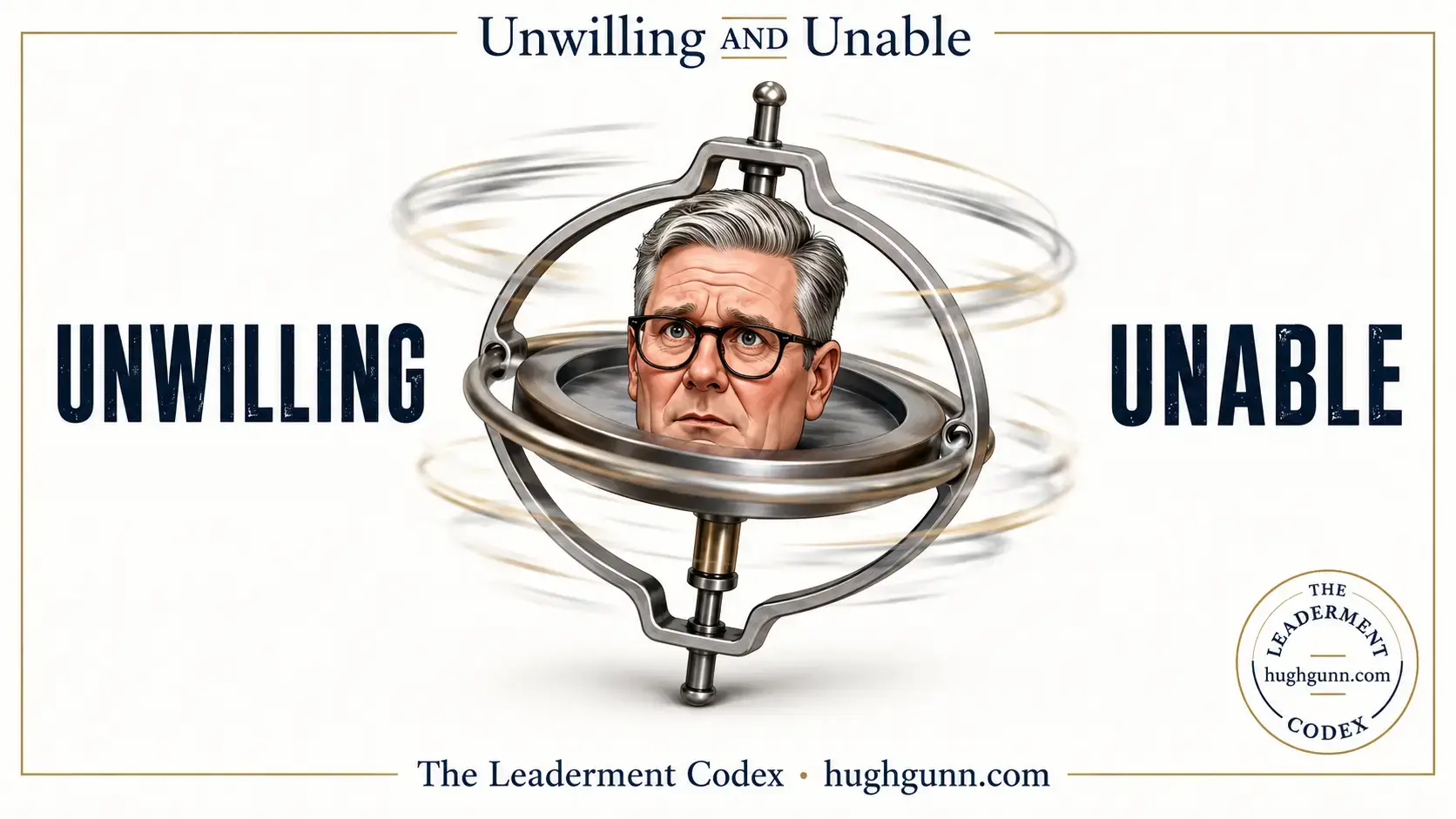
This government reminds me very much of a gyroscope — always spinning around at a frantic pace, but not really going anywhere.
When a cabinet minister resigns, the commentary class reads the drama and skips the detail. They did it again this week. The Defence Secretary walked out, and the story became the Prime Minister’s authority “draining away”. They were reading a soap opera. The story was in the letter.
Because John Healey’s resignation letter contained something rarer than grievance. It contained a measurement: that the Treasury had been unwilling to fund defence, and Number 10 had been unable to make it happen.
Could you imagine a Ship’s Captain claiming the ship sank because the pumping machinery was the statutory domain of the Marine Engineering Officer?
Two words. Most assume they are opposites. Choice versus capacity. Will versus power.
Unwilling: a refusal to act.
Unable: a failure of capacity.
But in systems, they converge.
To see why, you separate two things that wear the same suit.
Authority is the individual reserve:
Effective Power is what that reserve becomes when it is spent into the system:
Authority is not execution. It is currency. Effective Power is what happens when that currency is spent to force a system to move.
A leader converts one into the other only by willingness — the decision to spend standing, influence, and political capital.
If he will not spend, nothing moves. If he cannot spend, nothing moves. From the outside, there is no difference.
We still hear the same sentences:
“Due to circumstances beyond my control.”
“Due to the conditions I inherited.”
Translated, they mean: the Authority was not converted into Effective Power.
There are only two causes. Either resistance exists elsewhere in the system — or the centre will not apply enough force to overcome it. In practice, they look identical at the point of failure.
The Captain analogy makes it obvious.
A ship does not sink because the Captain lacked Authority. It sinks because Authority was not used to force the system to respond while it still could.
Once a Captain becomes a passenger on his own vessel, the crew no longer distinguishes between unwilling and unable.
They only observe one thing:
Stasis
And at that point, all that is left of Authority is the Captain’s hat.