You can trust an alcoholic to get drunk, a shoplifter to steal, and a politician to lie. None of that is a failure of trust. It is trust working perfectly.
Because trust was never the warm, general thing we treat it as. The real question is never do I trust this person. It is do I trust this person to do this, under these conditions, when it matters. I would trust a friend with my life and not with my wallet — and both judgements are correct, because they are scored against different contracts. Betrayal is not someone doing what you expected of them. It is someone doing the opposite of the specific thing you trusted them to do.
And trust is mechanical, not moral. It is not likability or tone; it is the permission that lets people take risks together — speak up, act, commit — instead of hedging. Where it is present, a system runs lean. Where it is absent, the system grows armour to compensate: process, oversight, sign-offs, permission structures. Low trust is paid for in bureaucracy — and that bill is the same Administrative Impotence that drags down every other equation in the book.
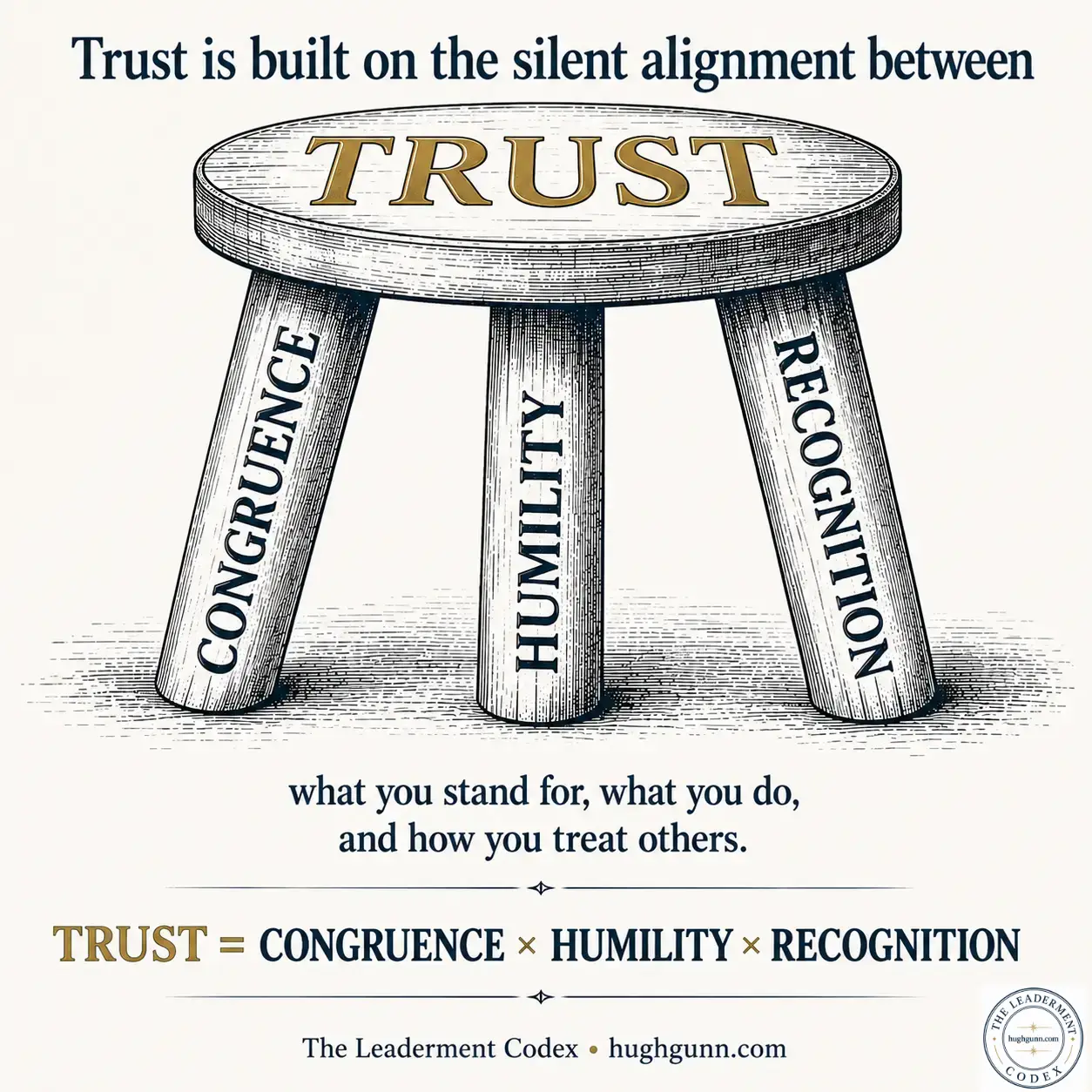
Trust = Congruence × Humility × RecognitionThree legs, and they multiply rather than add. Congruence — do your actions match your words. Humility — will you be corrected. Recognition — is contribution actually seen. Substantial recognition cannot rescue collapsed congruence; abundant humility cannot rescue a contribution nobody acknowledges. Kick away one leg and the stool does not wobble — it falls. The product is the score.
Trust is built on the silent alignment between what you stand for, what you do, and how you treat others.
Every leader runs two contracts at once: the stated one — what they claim to be doing — and the operating one, what their conduct shows they are actually doing. In healthy systems these are the same contract. In every great betrayal they have quietly diverged, and the audience went on scoring the leader against the contract they advertised while the leader ran the other. The Catholic Church scored at the floor against safeguard the children entrusted to us, and high against protect the institution from scandal. The horror is not that it failed. It is that it succeeded, competently, at the contract that should never have existed. The gap between the two is the whole diagnostic.
And here is the part people get wrong. When the audience finally catches up, trust does not collapse to nothing, and it does not go negative. It moves. “I don’t trust the government to look after me” quietly becomes “I trust it, with total confidence, to look after itself — at my expense.” That is not an absence of trust. It is a trust as firm as any other, pointed the opposite way: a confident, tradeable prediction that the leader will keep delivering the contract they were really running all along. Nobody stops trusting the fraudster. They start trusting him, completely, to be a fraudster.
Which is why the only real defence is to name the contract — to state it in words the other side can hold you to. A manifesto is exactly this: a contract written down and admissible in evidence. Naming does not make you trustworthy; it makes you measurable — and measurability is precisely what vagueness is built to avoid. “We will not raise taxes on working people” is engineered to sound like a promise while committing to nothing, because working people has no fixed meaning and can be redefined after the fact to suit. The honest leader names the terms up front and accepts being scored against them. The one who deflects has already told you which contract is real.
I learned the unforgiving version of this below the surface. On a submarine, trust is not a value on a poster — it is life support. You trust that the maintenance was done as logged, and that the watchkeeper will report what they actually see rather than what the captain wants to hear. A single gap between what was done and what was recorded can drown everyone aboard. There is no contract down there but the real one. The sea does not score you against the one you advertised.
So stop asking whether you trust someone. Ask what you are trusting them to do — and whether that is the contract they are actually running.